A Levels Chemistry (9701)•9701/11/M/J/18
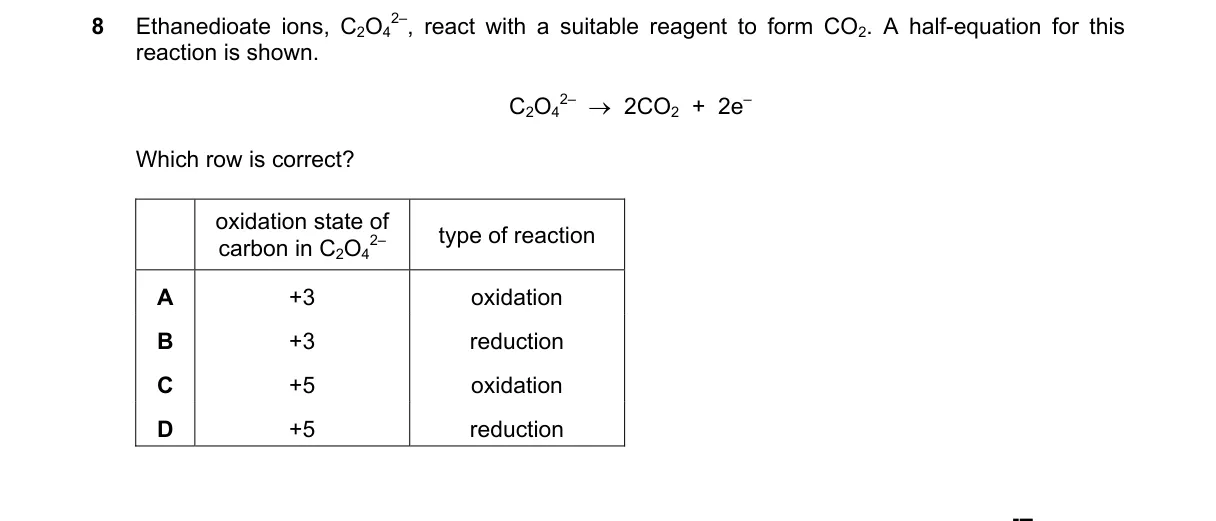
Explanation
Oxidation state change in oxalate half-reaction
Steps:
- Assign oxidation state to C in C₂O₄²⁻: 2x + 4(-2) = -2, so 2x = 6, x = +3 per C.
- Assign oxidation state to C in CO₂: x + 2(-2) = 0, so x = +4.
- Oxidation state rises from +3 to +4, indicating oxidation (loss of electrons).
- Half-equation shows 2e⁻ released, confirming oxidation process.
Why A is correct:
- Carbon starts at +3 and increases to +4, defining oxidation from the +3 state per IUPAC oxidation number rules.
Why the others are wrong:
- B: Reduction decreases oxidation state, but +3 to +4 increases it; +5 irrelevant.
- C: Oxidation occurs, but initial state is +3, not +5.
- D: Process is oxidation (electron loss), not reduction.
Final answer: A
Topic: Electrochemistry
Practice more A Levels Chemistry (9701) questions on mMCQ.me