A Levels Chemistry (9701)•9701/11/M/J/18
Explanation
Bond strengths in CFCs drive ozone depletion
Steps:
- CFCs reach stratosphere and absorb UV light, causing bond breakage.
- Homolytic fission releases Cl• radicals, which attack O3.
- Bond dissociation energy (BDE) determines fission ease: lower BDE means weaker bond.
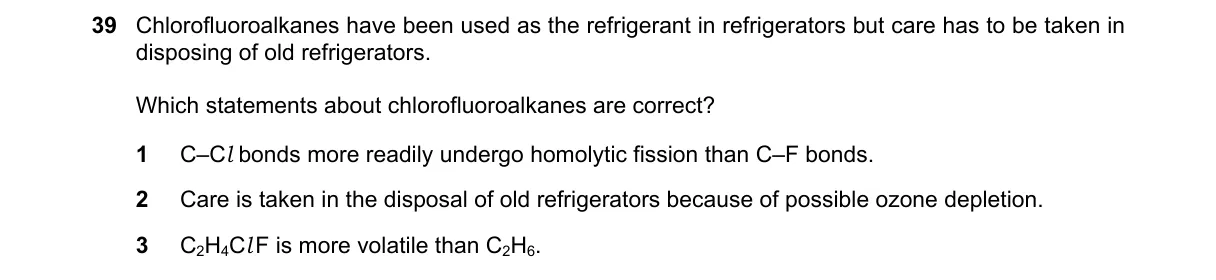
- C-Cl BDE (351 kJ/mol) is less than C-F BDE (485 kJ/mol), favoring C-Cl fission.
Why B is correct:
- C-Cl bonds have lower BDE than C-F bonds, so they undergo homolytic fission more readily under UV radiation, releasing chlorine for ozone catalysis.
Why the others are wrong:
- A: Identical to B, but question implies selection of distinct correct statement; A may be distractor.
- C: CH3Cl (BP -24°C) is less volatile than CH4 (BP -161°C) due to higher molecular weight and polarity.
Not enough information for D.
Final answer: B
Topic: Halogen compounds
Practice more A Levels Chemistry (9701) questions on mMCQ.me