A Levels Biology (9700)•9700/13/O/N/24
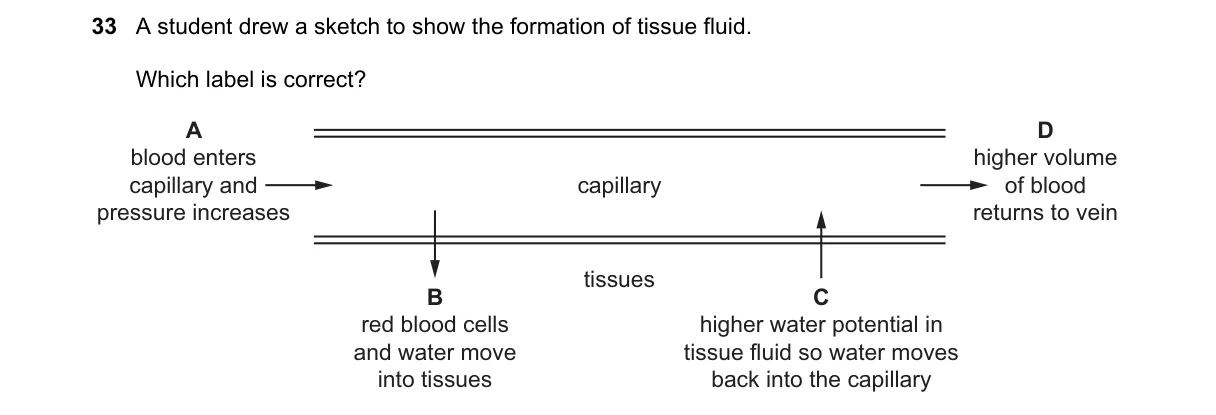
Explanation
Capillary exchange drives tissue fluid formation
Steps:
- Recall tissue fluid forms via filtration at capillary arterial end, where hydrostatic pressure pushes fluid out.
- Note water potential gradient: higher in tissues (fewer solutes) than plasma, but hydrostatic pressure dominates outflow.
- Compare labels to standard model: hydrostatic > osmotic at start, reverse at end.
- Identify correct label as the one matching tissue water potential.
Why C is correct:
- Water potential is higher in tissues than capillary plasma due to lower solute concentration (no plasma proteins), per water potential definition ψ = ψ_s + ψ_p, enabling net filtration.
Why the others are wrong:
- A: Hydrostatic pressure decreases along capillary, not increases.
- B: Red blood cells stay in capillaries; only water and small solutes form tissue fluid.
- D: Less blood volume returns to veins due to filtration loss, balanced by lymph.
Final answer: C
Topic: The circulatory system
Practice more A Levels Biology (9700) questions on mMCQ.me