A Levels Biology (9700)•9700/12/O/N/24
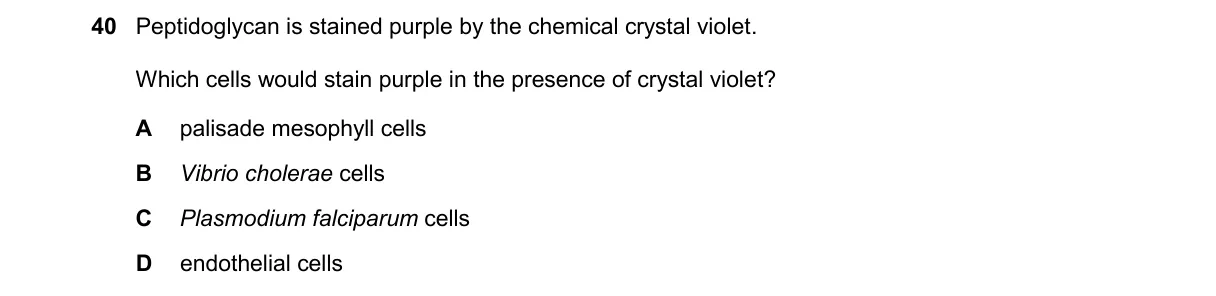
Explanation
Crystal violet targets bacterial peptidoglycan for purple staining
Steps:
- Crystal violet binds to peptidoglycan, a polymer unique to bacterial cell walls, causing purple staining.
- Identify options: only bacteria possess peptidoglycan; eukaryotes like plants, animals, and protozoa do not.
- Vibrio cholerae is a bacterium, so its cell wall contains peptidoglycan.
- Eliminate non-bacterial options lacking peptidoglycan.
Why B is correct:
- Vibrio cholerae is a Gram-negative bacterium with a thin peptidoglycan layer that retains crystal violet dye, staining purple per Gram staining principles.
Why the others are wrong:
- A: Palisade mesophyll cells are plant cells with cellulose walls, lacking peptidoglycan.
- C: Plasmodium falciparum is a protozoan parasite without peptidoglycan in its structure.
- D: Endothelial cells are eukaryotic animal cells with no peptidoglycan.
Final answer: B
Topic: Cells as the basic units of living organisms
Practice more A Levels Biology (9700) questions on mMCQ.me