A Levels Biology (9700)•9700/12/O/N/24
Explanation
Proton Gradient Drives Sucrose Loading in Phloem
Steps:
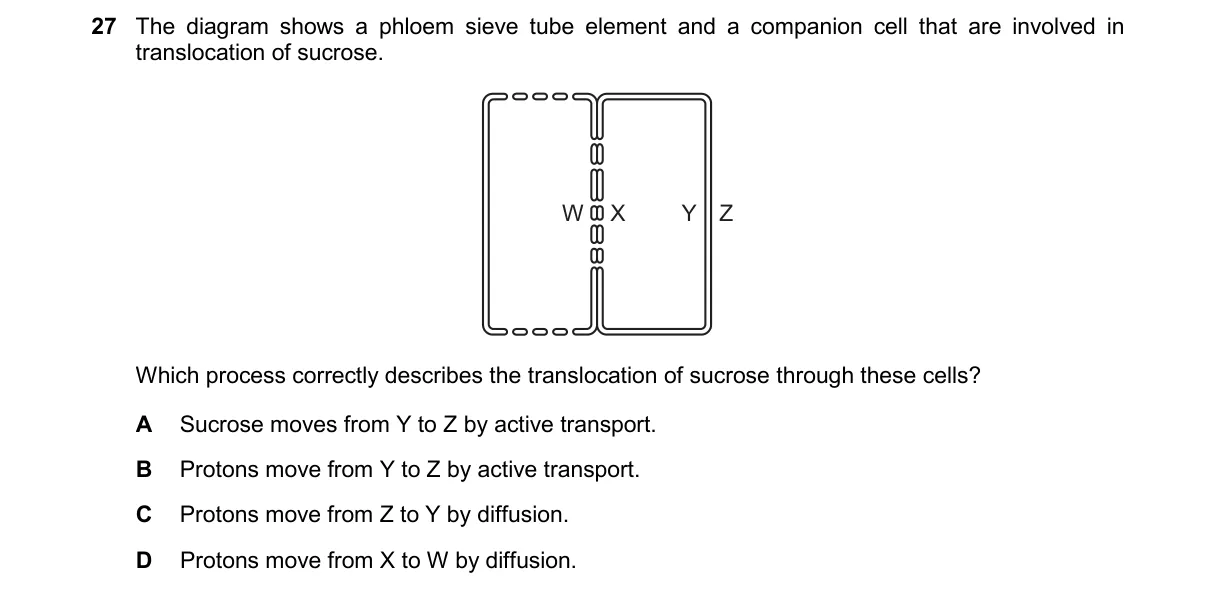
- Companion cell cytoplasm (X) actively pumps H+ into apoplast (Y) using ATP, establishing an electrochemical gradient.
- Sucrose in apoplast (Y) binds with H+ via symporter protein.
- H+ moves from Y to sieve tube/companion cell (Z) down its gradient, co-transporting sucrose.
- Loaded sucrose enables mass flow in phloem.
Why B is correct:
- Protons move from apoplast (Y) to cell interior (Z) by facilitated diffusion down the electrochemical gradient created by active pumping, as per the chemiosmotic principle.
Why the others are wrong:
- A: Sucrose moves from Y to Z by secondary active transport via symport, not primary active transport.
- C: Protons move from X to Y by active transport using proton ATPase, not diffusion.
- D: Sucrose moves from Y to Z (not Z to X) by secondary active transport, not primary active.
Final answer: B
Topic: Transport mechanisms
Practice more A Levels Biology (9700) questions on mMCQ.me