A Levels Biology (9700)•9700/12/O/N/24
Explanation
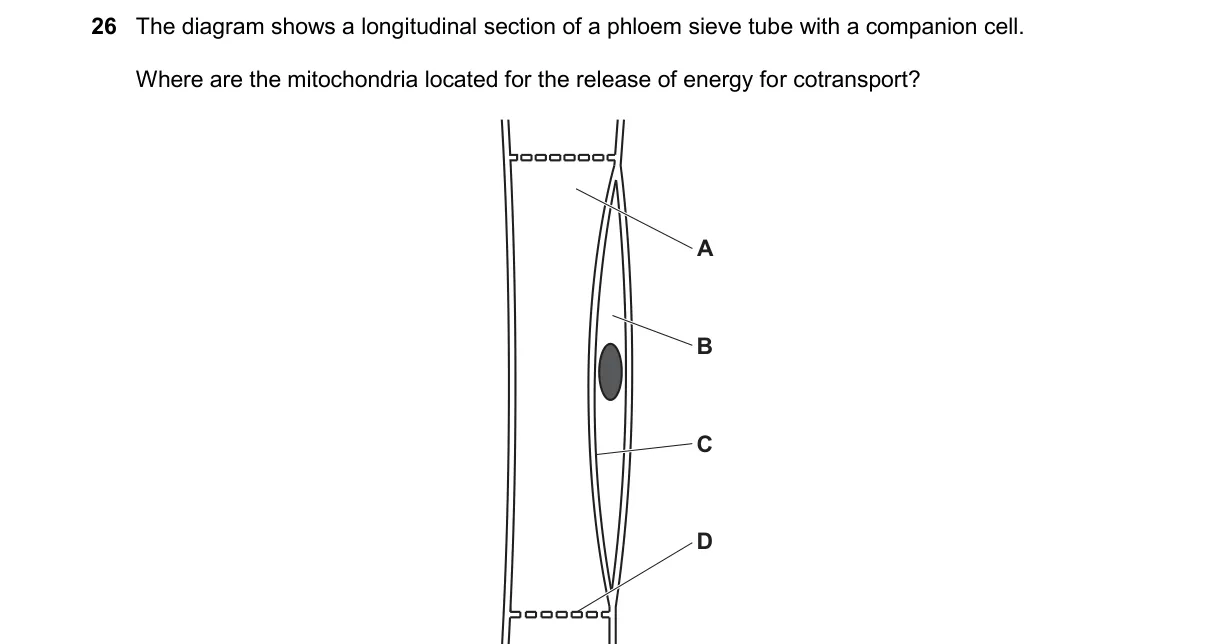
Mitochondria in Companion Cells Power Phloem Loading
Steps:
- Sieve tubes lack nuclei and organelles, relying on companion cells for metabolic support.
- Cotransport of sucrose into sieve tubes requires ATP for proton pumps.
- Companion cells generate ATP via mitochondria to drive this active loading process.
- Diagram positions confirm mitochondria in companion cell region.
Why B is correct:
- Companion cells house mitochondria that produce ATP for H+/sucrose cotransport, enabling phloem loading per the companion cell-sieve tube functional unit definition.
Why the others are wrong:
- A: Sieve tube interior lacks mitochondria, as it contains only cytoplasm for mass flow.
- C: Sieve plate area has no organelles, serving only for translocation.
- D: Cell wall or exterior has no cellular components for energy production.
Final answer: B
Topic: Structure of transport tissues
Practice more A Levels Biology (9700) questions on mMCQ.me