A Levels Biology (9700)•9700/11/O/N/24
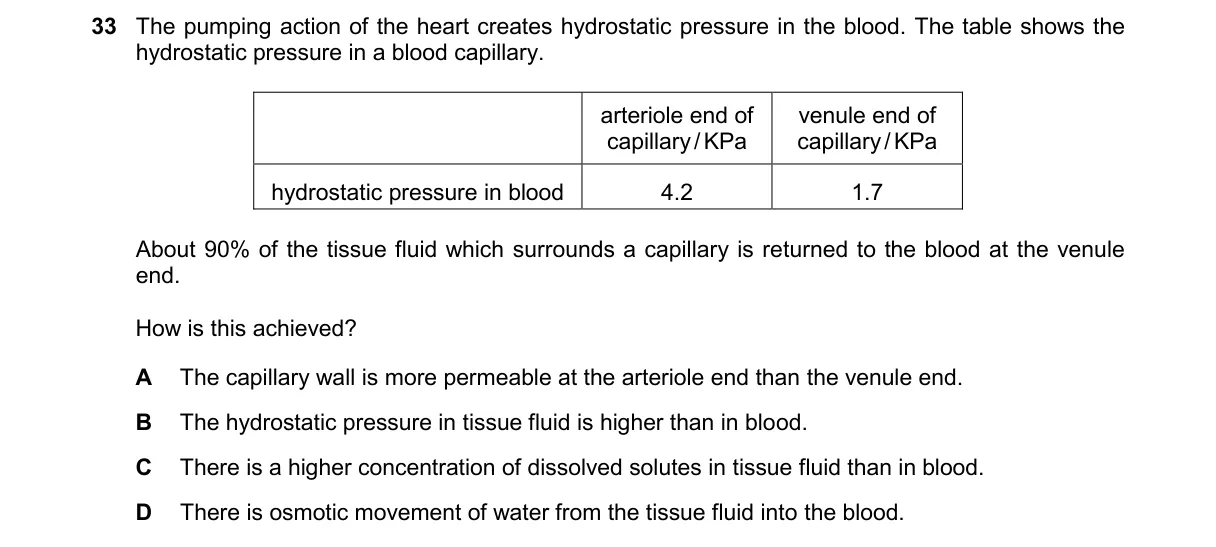
Explanation
Osmosis enables fluid reabsorption at the venous end Steps:
- Hydrostatic pressure drops from 4.2 kPa at the arterial end to 1.7 kPa at the venous end, reducing outward force.
- Blood plasma proteins create colloid osmotic pressure (about 3.3 kPa), constant along the capillary.
- At the arterial end, hydrostatic pressure exceeds osmotic pressure, causing net filtration out.
- At the venous end, osmotic pressure exceeds hydrostatic pressure, causing net water movement into the blood.
Why D is correct:
- Osmosis is the diffusion of water across a semipermeable membrane from low to high solute concentration, driven here by higher plasma protein concentration pulling water back per Starling's hypothesis.
Why the others are wrong:
- A: Capillary permeability is uniform; pressure gradient, not permeability, controls direction.
- B: Tissue fluid hydrostatic pressure is near zero, lower than blood's 1.7 kPa, favoring inflow.
- C: Plasma has higher solute concentration (proteins) than tissue fluid, driving osmosis inward.
Final answer: D
Topic: The circulatory system
Practice more A Levels Biology (9700) questions on mMCQ.me