A Levels Biology (9700)•9700/11/O/N/24
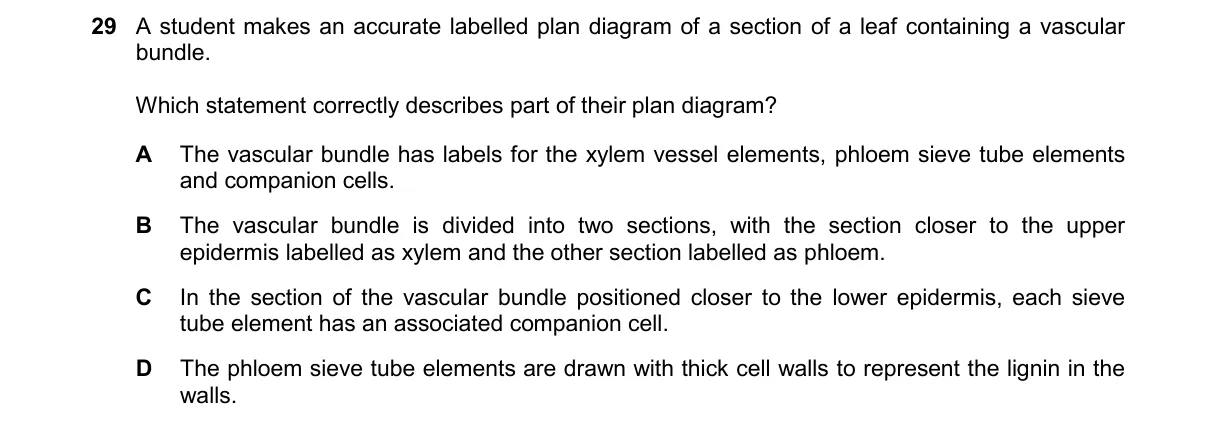
Explanation
Vascular bundle structure in leaves
Steps:
- Recall that leaf vascular bundles in dicotyledons consist of xylem and phloem, with phloem positioned towards the upper epidermis and xylem towards the lower.
- Examine option B: it describes the bundle divided into two sections, phloem closer to upper epidermis, matching standard anatomy.
- Evaluate other options for inaccuracies in labeling, positioning, or features.
- Confirm B aligns with the accurate plan diagram by reflecting the correct orientation.
Why B is correct:
- In leaf vascular bundles, phloem is located adaxially (towards upper epidermis) for efficient sugar transport, as per plant anatomy definitions.
Why the others are wrong:
- A: Companion cells are part of phloem, but the option incorrectly implies they are separate from sieve tube elements in labeling.
- C: Companion cells are adjacent to sieve tube elements throughout the phloem, not specifically closer to the lower epidermis.
- D: Phloem sieve tube elements have thin, non-lignified walls for easy flow, unlike thick-walled xylem.
Final answer: B
Topic: Structure of transport tissues
Practice more A Levels Biology (9700) questions on mMCQ.me