A Levels Biology (9700)•9700/11/O/N/24
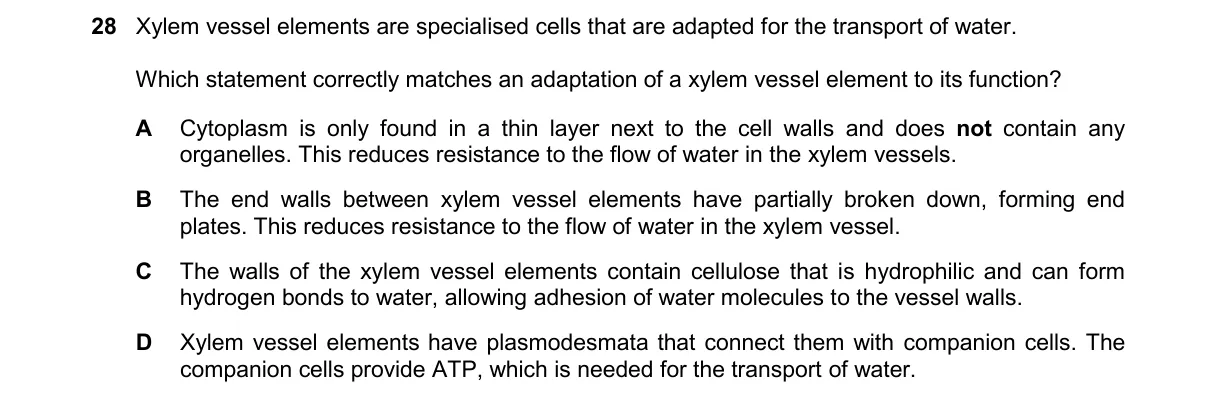
Explanation
Xylem Vessel Adaptations for Efficient Water Transport
Steps:
- Identify key features of xylem vessels: dead, hollow cells with lignified walls for unidirectional water flow via transpiration pull.
- Evaluate options for structural adaptations that minimize resistance and maximize water adhesion.
- Eliminate inaccuracies about living cell features or incorrect associations.
- Confirm the option aligning with hydrophilic properties for capillary action.
Why C is correct:
- Cellulose in walls is hydrophilic, forming hydrogen bonds with water to enable adhesion and capillary rise, per principles of cohesion-tension theory.
Why the others are wrong:
- A: Xylem vessels are dead cells lacking cytoplasm and organelles entirely.
- B: End walls are perforated or absent, but this forms continuous tubes; resistance reduction is due to width and smoothness, not just end walls.
- D: Xylem vessels lack plasmodesmata and companion cells, which are phloem features for active transport.
Final answer: C
Topic: Structure of transport tissues
Practice more A Levels Biology (9700) questions on mMCQ.me