A Levels Biology (9700)•9700/13/O/N/23
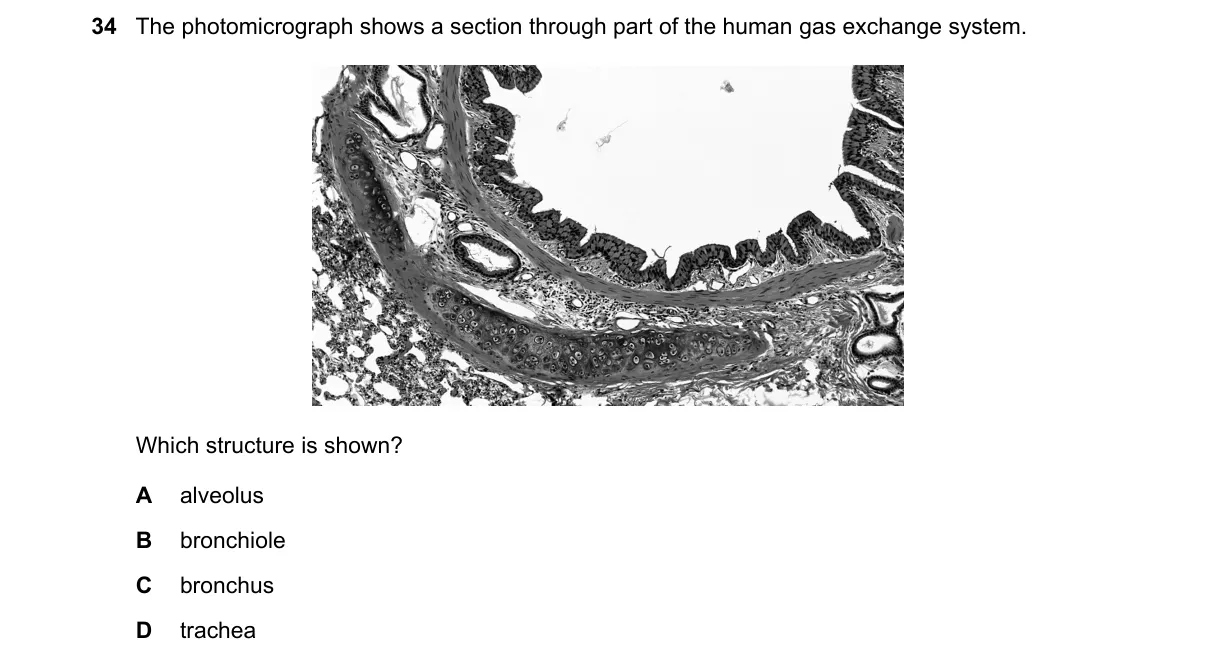
Explanation
Identifying respiratory structures via histological features
Steps:
- Check for cartilage presence: larger airways like bronchi and trachea contain it, unlike alveoli or bronchioles.
- Assess cartilage arrangement: incomplete rings indicate trachea, irregular plates suggest bronchi.
- Evaluate wall thickness and epithelium: thicker walls with glands and cilia point to conducting airways.
- Confirm size relative to branching: post-tracheal branching with plates identifies bronchi.
Why C is correct:
- Bronchi feature irregular cartilaginous plates in their walls, providing structural support in cross-sections as per respiratory anatomy definitions.
Why the others are wrong:
- A: Alveoli are thin, elastic sacs lined by simple squamous epithelium for gas exchange, without cartilage.
- B: Bronchioles lack cartilage, relying on smooth muscle for diameter control in smaller airways.
- D: Trachea has distinct C-shaped hyaline cartilage rings encircling most of its posterior wall.
Final answer: C
Topic: The gas exchange system
Practice more A Levels Biology (9700) questions on mMCQ.me