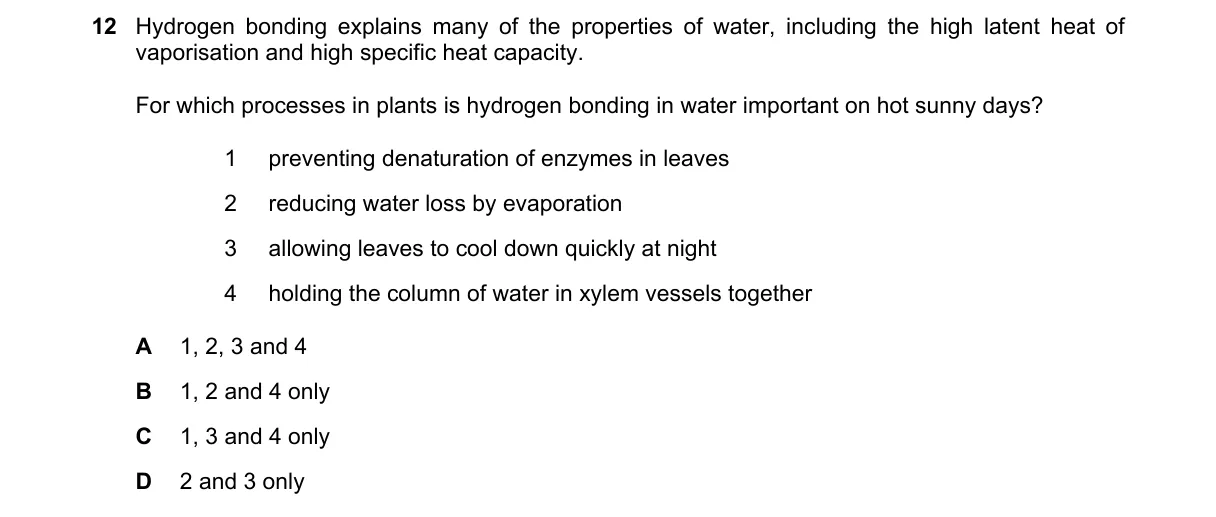
Explanation
Hydrogen bonding's role in water properties for plant processes on hot days Steps: - Option 1 correct: High specific heat capacity from hydrogen bonds stabilizes leaf temperature against solar heating, preventing enzyme denaturation. - Option 2 correct: High latent heat of vaporization from hydrogen bonds removes more heat per unit water evaporated, reducing overall water loss during transpiration cooling. - Option 3 incorrect: High specific heat slows temperature drop, hindering quick nighttime cooling; irrelevant to hot sunny days. - Option 4 correct: Hydrogen bonds enable cohesion-tension, holding unbroken water columns in xylem for continuous upward flow under high evaporation. Why B is correct: - B includes 1, 2, and 4, matching hydrogen bonding's contributions to specific heat (temperature stability), latent heat (efficient cooling), and cohesion (water transport) per cohesion-tension theory. Why the others are wrong: - A: Omits 4, neglecting cohesion's role in sustaining transpiration-driven water ascent on hot days. - C: Includes 3, which contradicts specific heat's slowing effect on cooling and ignores daytime context. - D: Includes 3 and excludes 1 and 4, overlooking heat buffering and xylem …
Practice more A Levels Biology (9700) questions on mMCQ.me