A Levels Biology (9700)•9700/12/O/N/23
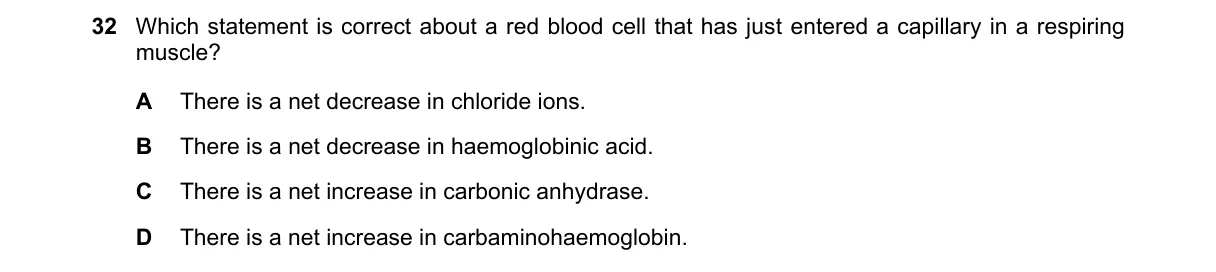
Explanation
CO2 Transport in Tissue Capillaries
Steps:
- CO2 produced by resting muscle diffuses into the capillary blood and enters the RBC.
- A portion of CO2 reacts with hemoglobin's amino groups to form carbaminohemoglobin.
- This binding increases carbaminohemoglobin levels in the RBC as it picks up CO2.
- Deoxygenation of hemoglobin facilitates this CO2 binding process.
Why D is correct:
- Carbaminohemoglobin forms via Hb-NH₂ + CO₂ → Hb-NH-COOH, transporting 20-30% of CO₂ from tissues to lungs.
Why the others are wrong:
- A: Chloride shift during HCO₃⁻ efflux causes Cl⁻ influx into the RBC, leading to net increase.
- B: Haemoglobinic acid (HHb) increases to buffer H⁺ from CO₂ hydration.
- C: Carbonic anhydrase is a fixed enzyme in RBCs; its amount does not change.
Final answer: D
Topic: Transport of oxygen and carbon dioxide
Practice more A Levels Biology (9700) questions on mMCQ.me