A Levels Biology (9700)•9700/12/O/N/23
Explanation
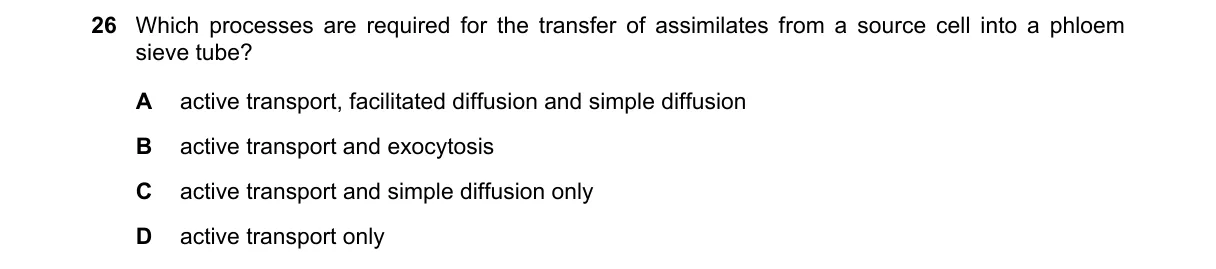
Mechanisms of Phloem Loading for Assimilates
Steps:
- Assimilates like sucrose are produced in source mesophyll cells and must enter phloem sieve tubes against a concentration gradient.
- In apoplastic loading, sucrose exits mesophyll cells into the apoplast via simple diffusion through membrane channels.
- Sucrose then enters companion cells via facilitated diffusion coupled with active proton pumping (H+-sucrose symporters).
- From companion cells, sucrose moves to sieve tubes via plasmodesmata, involving facilitated diffusion, while active transport maintains the gradient.
Why A is correct:
- Phloem loading follows the mass flow hypothesis, requiring active transport to build osmotic pressure, facilitated diffusion for sucrose-proton cotransport, and simple diffusion for apoplastic release, as defined in plant transport physiology.
Why the others are wrong:
- B: Exocytosis is not involved in assimilate transfer; it's mainly for protein secretion.
- C: Omits facilitated diffusion essential for symport across companion cell membranes.
- D: Ignores diffusion processes needed for sucrose movement between cells and apoplast.
Final answer: A
Topic: Transport mechanisms
Practice more A Levels Biology (9700) questions on mMCQ.me