A Levels Biology (9700)•9700/12/O/N/23
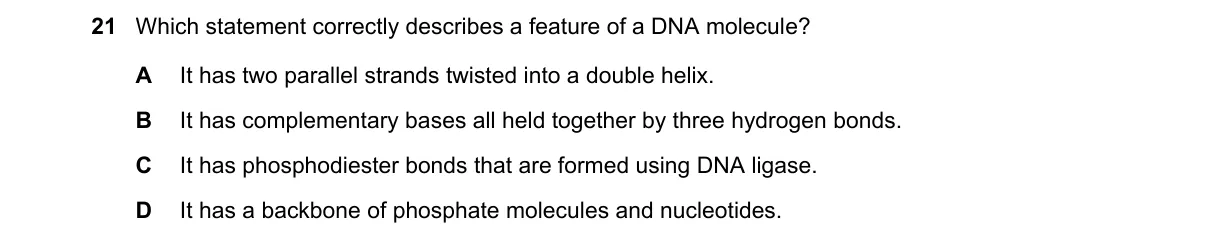
Explanation
DNA Structure and Bonding
Steps:
- Recall DNA's double helix consists of two antiparallel strands with complementary base pairing.
- Identify backbone formation: nucleotides link via phosphodiester bonds between sugar and phosphate.
- Note enzymes involved: DNA polymerase synthesizes most bonds, but DNA ligase seals nicks in replication.
- Evaluate each option against standard DNA features.
Why C is correct:
- Phosphodiester bonds form the sugar-phosphate backbone; DNA ligase catalyzes their formation during replication by joining Okazaki fragments (per molecular biology definition of ligation).
Why the others are wrong:
- A: Strands are antiparallel, not parallel.
- B: A-T pairs have two hydrogen bonds; only G-C has three.
- D: Backbone consists of phosphate-sugar alternating units, not "phosphate molecules and nucleotides" (nucleotides are the full monomers).
Final answer: C
Topic: Structure of nucleic acids and replication of DNA
Practice more A Levels Biology (9700) questions on mMCQ.me