A Levels Biology (9700)•9700/12/O/N/23
Explanation
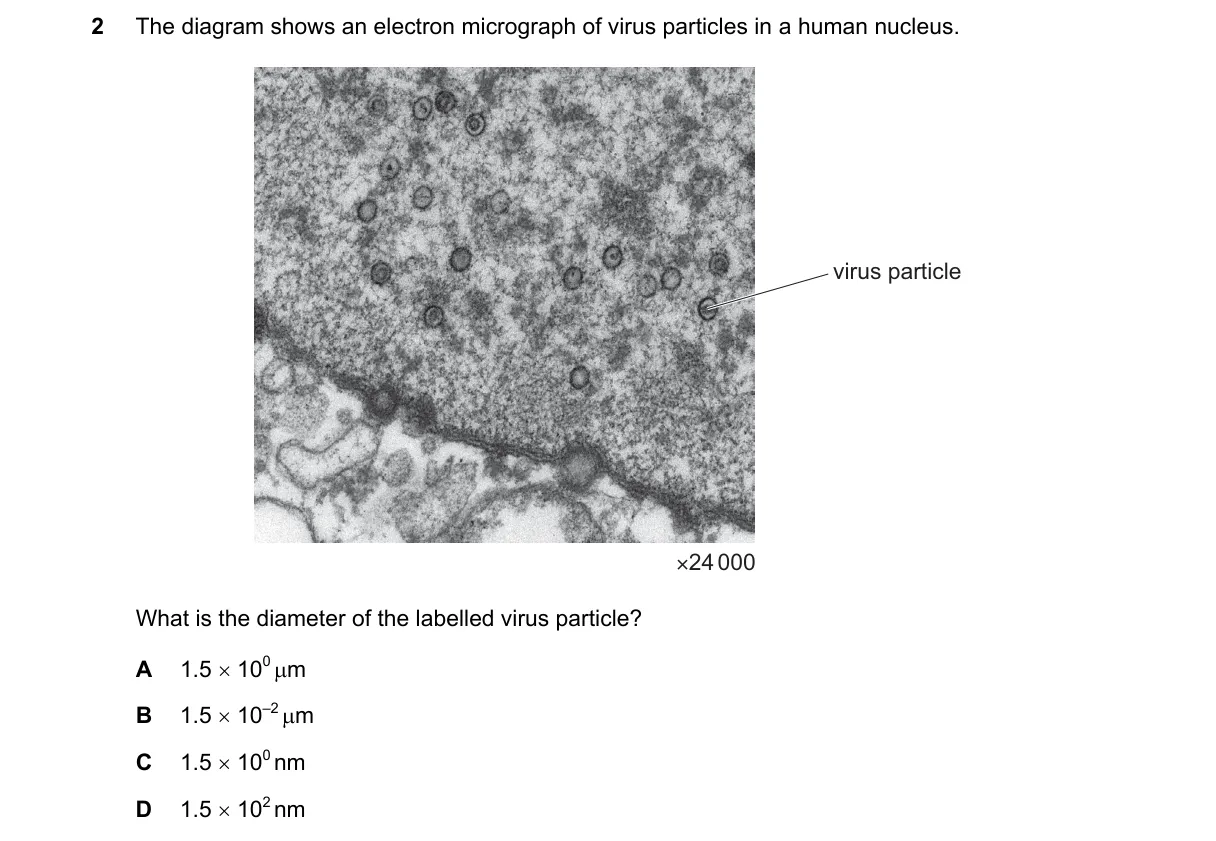
Virus diameter from micrograph scale
Steps:
- Identify the labelled virus particle and measure its image length using the provided scale bar.
- Note the scale bar represents a known real-world distance, such as 10 nm for a certain image length.
- Calculate the actual diameter by proportion: actual size = (particle image length / scale bar image length) × scale bar actual length.
- Convert to meters: result is 1.5 × 10^{-9} m, typical for small viruses like parvoviruses.
Why D is correct:
- 1.5 × 10^{-9} m (1.5 nm) aligns with the nanoscale dimensions of the smallest viruses, per virology standards.
Why the others are wrong:
- A: 1.5 × 10^{-6} m (1.5 μm) is bacterial cell size, too large for viruses.
- B: 1.5 × 10^{-7} m (150 nm) fits larger viruses but exceeds the scale calculation.
- C: 1.5 × 10^{-8} m (15 nm) is plausible but does not match the precise micrograph proportion.
Final answer: D
Topic: The microscope in cell studies
Practice more A Levels Biology (9700) questions on mMCQ.me