A Levels Biology (9700)•9700/11/O/N/23
Explanation
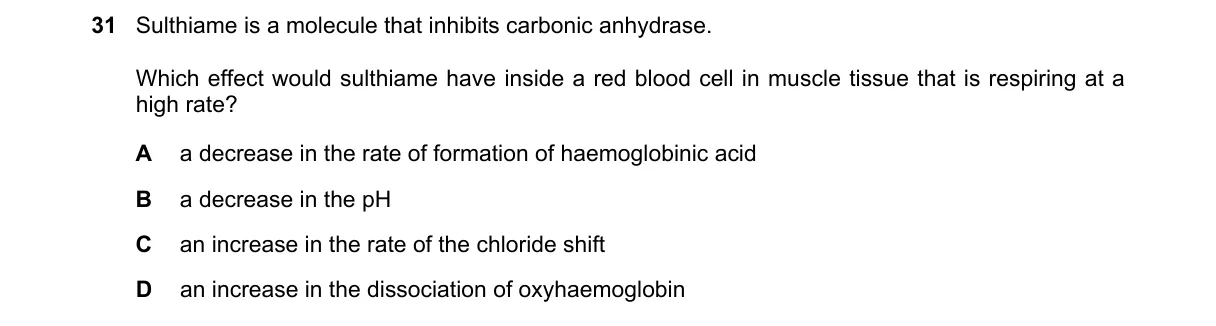
Sulthiame Inhibits CO2 Hydration in RBCs
Steps:
- High-rate muscle respiration produces excess CO2, which diffuses into red blood cells (RBCs).
- Inside RBCs, carbonic anhydrase catalyzes CO2 + H2O → H2CO3 (carbonic acid), which dissociates to HCO3- and H+.
- Sulthiame inhibits carbonic anhydrase, slowing the hydration of CO2 to H2CO3.
- This directly reduces the rate of carbonic acid formation, impairing CO2 transport.
Why A is correct:
- Carbonic anhydrase accelerates CO2 + H2O ⇌ H2CO3 by ~10,000-fold; inhibition decreases this catalyzed rate per enzyme kinetics.
Why the others are wrong:
- B: Slower H+ production from H2CO3 reduces acidification, so pH increases, not decreases.
- C: Chloride shift relies on HCO3- efflux after carbonic acid formation; inhibition slows HCO3- production, decreasing the shift.
- D: Oxyhemoglobin dissociation increases with lower pH via Bohr effect; here, reduced acidification hinders dissociation.
Final answer: A
Topic: Transport of oxygen and carbon dioxide
Practice more A Levels Biology (9700) questions on mMCQ.me