A Levels Biology (9700)•9700/11/O/N/23
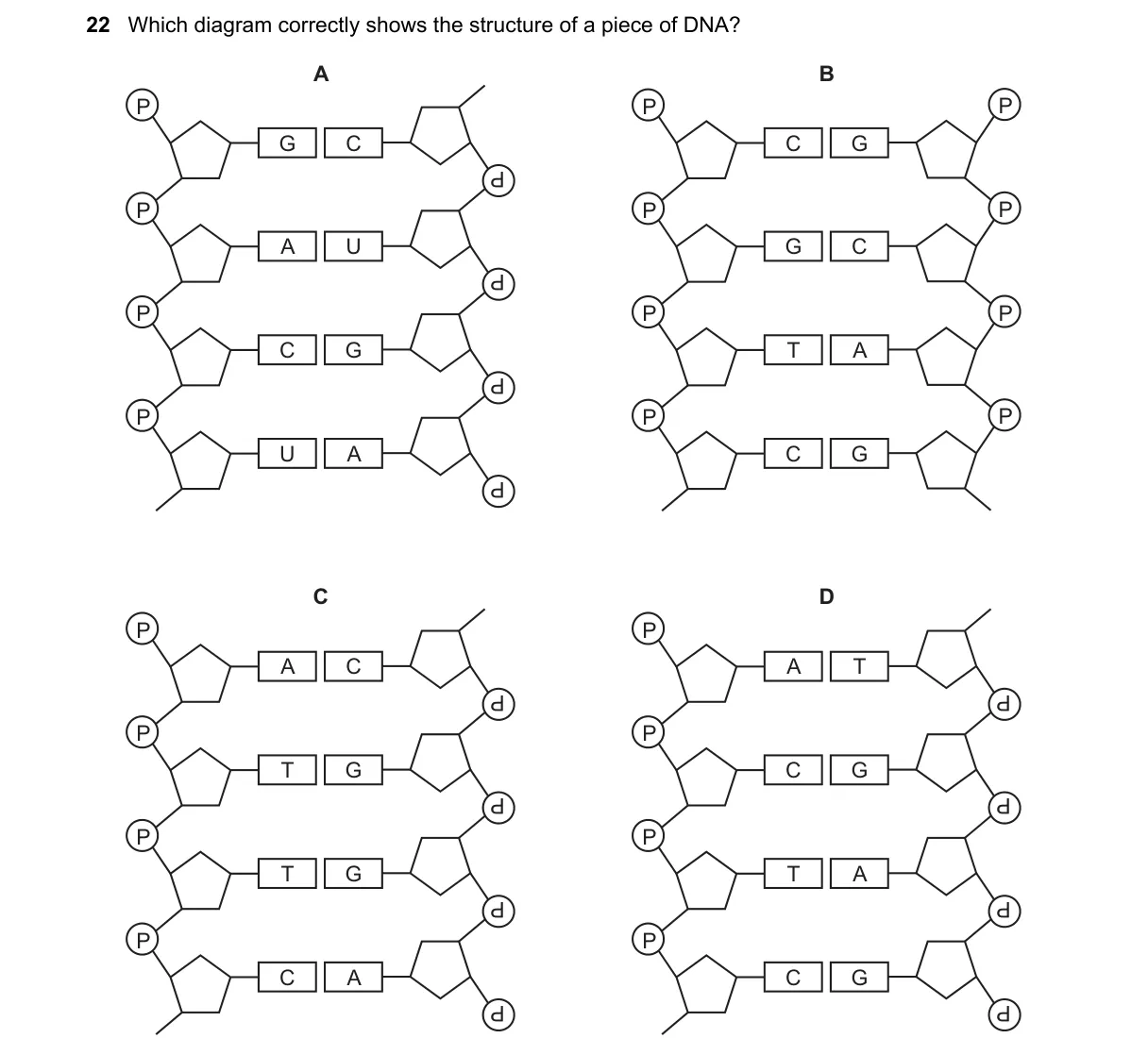
Explanation
DNA's Double Helix Structure
Steps:
- Recall DNA consists of two antiparallel strands forming a double helix with sugar-phosphate backbones and base pairs (A-T, G-C).
- Examine each diagram for correct ladder-like rungs (base pairs) and twisted rails (backbones).
- Check for proper orientation: strands run opposite directions (5' to 3').
- Identify the diagram matching Watson-Crick model.
Why D is correct:
- D depicts two antiparallel strands with complementary base pairing (A-T, G-C) and helical twist, aligning with the Watson-Crick double helix definition.
Why the others are wrong:
- A shows a single strand, ignoring DNA's double-stranded nature.
- B has incorrect base pairing (e.g., A-G), violating Chargaff's rules.
- C illustrates parallel strands, contradicting antiparallel orientation.
Final answer: D
Topic: Structure of nucleic acids and replication of DNA
Practice more A Levels Biology (9700) questions on mMCQ.me