A Levels Biology (9700)•9700/11/O/N/23
Explanation
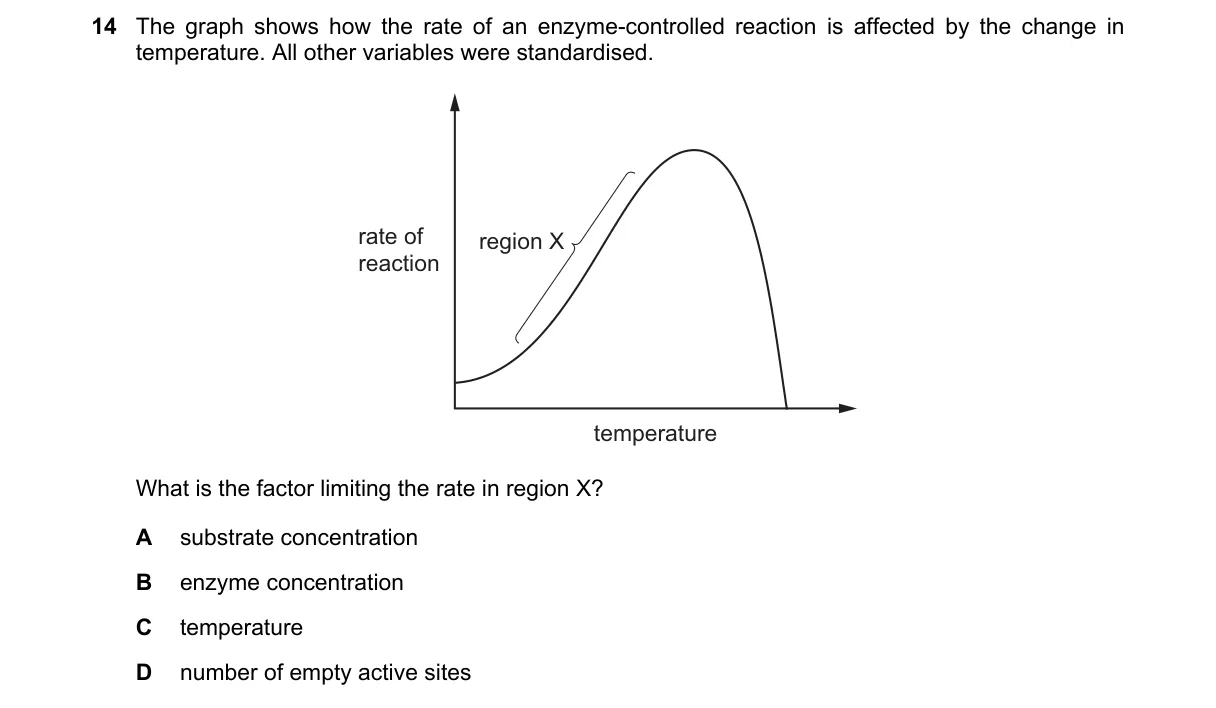
Temperature limits enzyme reaction rate in initial rising phase
Steps:
- Identify region X as the initial increasing part of the rate vs. temperature graph, where rate rises with temperature.
- Note that all variables except temperature are standardized, isolating temperature as the variable factor.
- Recall that enzyme reaction rates follow collision theory: higher temperature increases molecular collisions and kinetic energy, accelerating the reaction.
- Conclude that in region X, low temperature restricts collision frequency, limiting the rate.
Why C is correct:
- Per collision theory, temperature governs the rate of effective enzyme-substrate collisions; below optimum, insufficient thermal energy slows catalysis.
Why the others are wrong:
- A: Substrate concentration is standardized, so it does not vary or limit the rate.
- B: Enzyme concentration is standardized, maintaining constant enzyme availability.
- D: Empty active sites relate to substrate saturation (Michaelis-Menten kinetics), but standardized conditions and temperature-driven kinetics make this irrelevant in region X.
Final answer: C
Topic: Factors that affect enzyme action
Practice more A Levels Biology (9700) questions on mMCQ.me