A Levels Biology (9700)•9700/13/O/N/22
Explanation
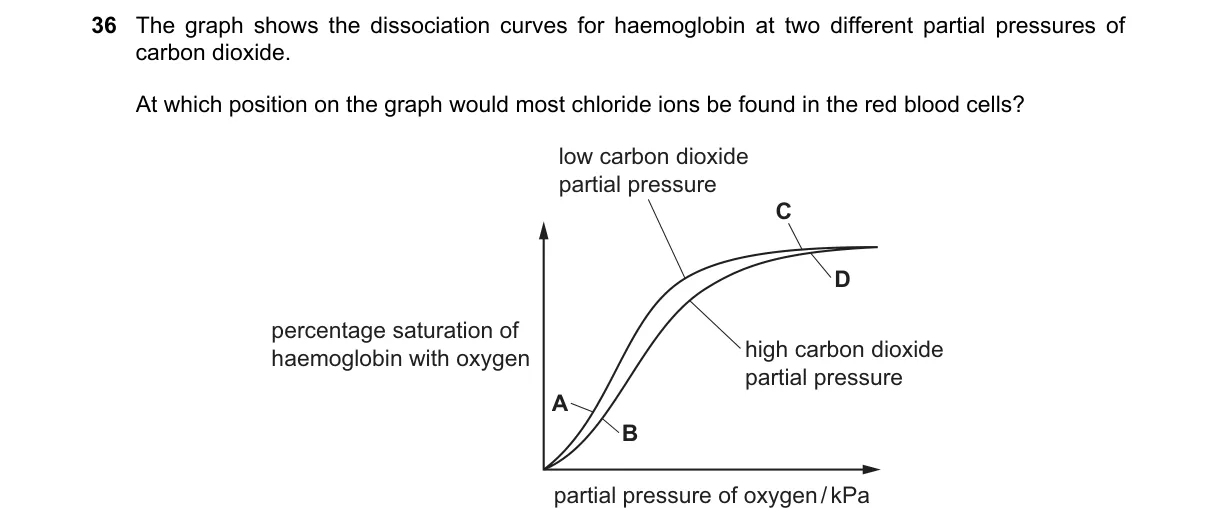
Chloride-bicarbonate shift maximizes ions in RBCs at high PCO2 and low PO2
Steps:
- CO2 diffuses into RBCs and converts to HCO3- and H+ via carbonic anhydrase, increasing intracellular ions.
- HCO3- exits RBCs via band 3 exchanger, importing Cl- ions (chloride shift), further elevating RBC ion concentration.
- This shift is enhanced by high PCO2, which right-shifts the O2 dissociation curve (Bohr effect), promoting O2 unloading.
- Maximum ions occur where high PCO2 meets low PO2, as in tissues, corresponding to the right-shifted curve's lower saturation point.
Why B is correct:
- Position B lies on the high PCO2 curve at low PO2, where CO2 loading drives maximal HCO3-/Cl- exchange per the chloride shift mechanism.
Why the others are wrong:
- A: On low PCO2 curve, minimal CO2 conversion limits ion influx.
- C: High saturation on high PCO2 curve means less O2 unloading, reducing shift efficiency.
- D: On low PCO2 curve at high PO2, negligible CO2 effect keeps ions low.
Final answer: B
Topic: Transport of oxygen and carbon dioxide
Practice more A Levels Biology (9700) questions on mMCQ.me