A Levels Biology (9700)•9700/13/O/N/22
Explanation
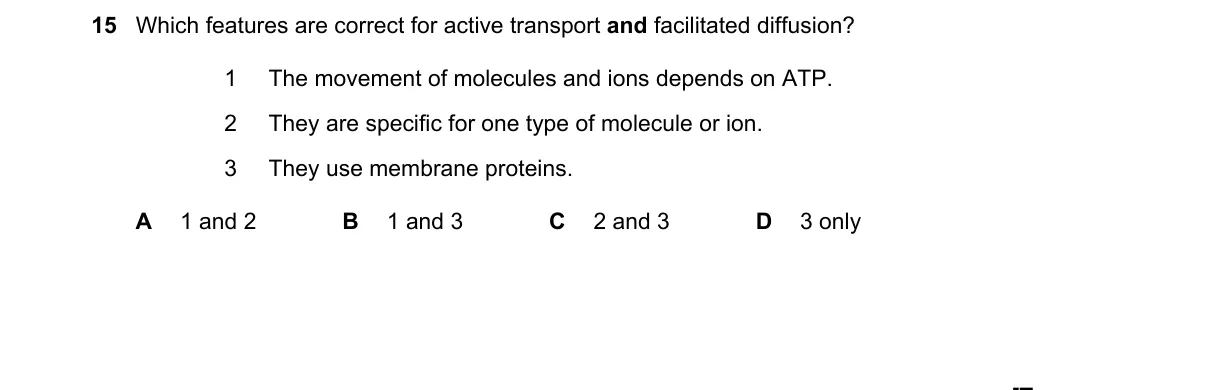
Shared mechanisms in active transport and facilitated diffusion
Steps:
- Active transport uses ATP to move molecules against their concentration gradient via carrier proteins.
- Facilitated diffusion moves molecules down their gradient through channel or carrier proteins without energy input.
- Both processes require specific membrane proteins for transport and exhibit saturation at high substrate concentrations.
- Options identify correct shared features as 2 (protein involvement) and 3 (saturation kinetics), corresponding to choice C.
Why C is correct:
- Both active transport and facilitated diffusion rely on membrane proteins that can become saturated, as defined by Michaelis-Menten kinetics in carrier-mediated transport.
Why the others are wrong:
- A includes 1, which likely refers to energy requirement—true only for active transport, not facilitated diffusion.
- B includes 1, incorrectly pairing it with 3.
- D omits 2, ignoring the shared use of transport proteins.
Final answer: C
Topic: Movement into and out of cells
Practice more A Levels Biology (9700) questions on mMCQ.me