A Levels Biology (9700)•9700/12/O/N/22
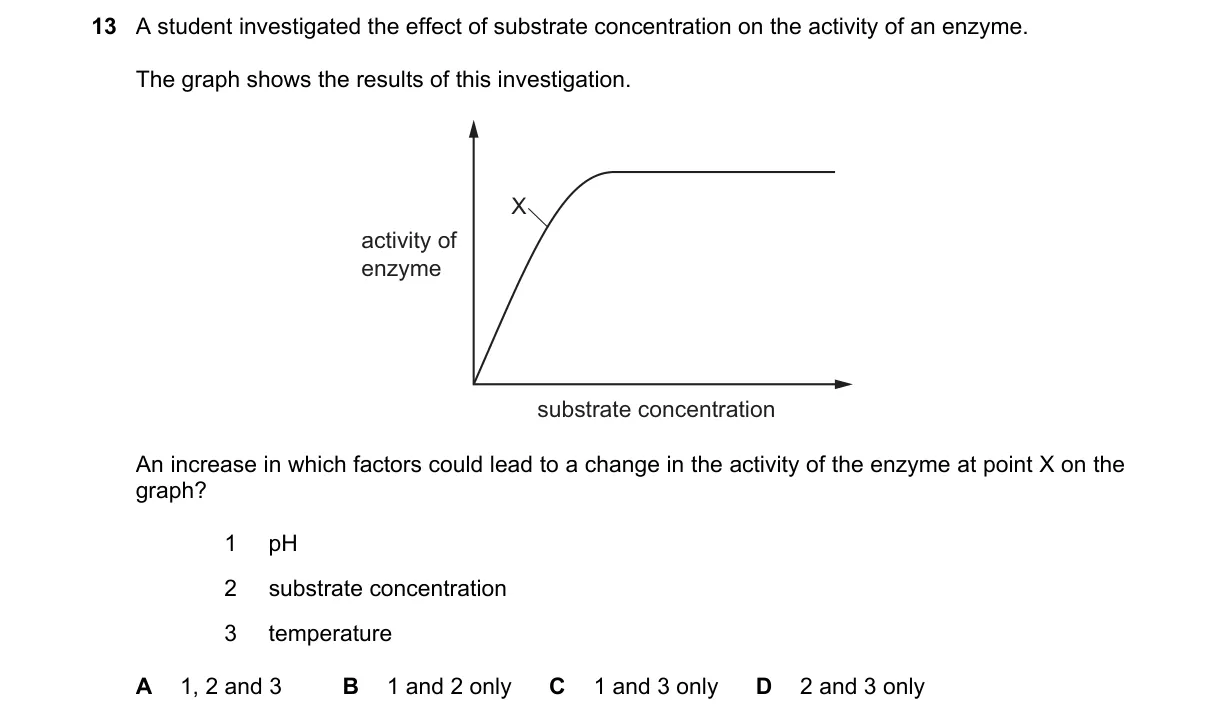
Explanation
Factors Affecting Enzyme Vmax at Saturation
Steps:
- Locate point X on the graph: it marks the plateau where reaction rate reaches Vmax, independent of further substrate increase.
- Recall enzyme kinetics: at high substrate concentration, all active sites are occupied, so rate depends on enzyme amount and conditions, not substrate.
- Evaluate factor 1 (enzyme concentration): increasing it raises Vmax by providing more active sites, altering activity at X.
- Evaluate factors 2 and 3: factor 2 (temperature) boosts catalytic rate up to optimum, changing Vmax; factor 3 (substrate concentration) has no effect at saturation.
Why A is correct:
- A selects factors 1 and 2, which directly increase Vmax per Michaelis-Menten kinetics, where Vmax = k_cat * [E_total].
Why the others are wrong:
- B omits factor 1, ignoring enzyme concentration's role in Vmax.
- C omits factor 2, overlooking temperature's impact on reaction rate.
- D includes factor 3, but substrate increase does not affect saturated enzyme activity.
Final answer: A
Topic: Factors that affect enzyme action
Practice more A Levels Biology (9700) questions on mMCQ.me