A Levels Biology (9700)•9700/11/O/N/22
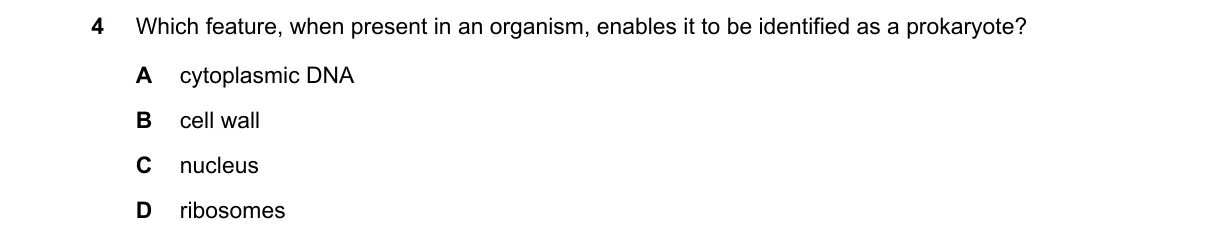
Explanation
Prokaryotes Have DNA in Cytoplasm, Not Nucleus
Steps:
- Define prokaryote: unicellular organism lacking a membrane-bound nucleus.
- Note key trait: genetic material (DNA) exists as nucleoid in cytoplasm.
- Contrast with eukaryote: DNA enclosed in nucleus.
- Identify feature: cytoplasmic DNA distinguishes prokaryotes.
Why A is correct:
- Prokaryotes contain a single circular DNA molecule free in the cytoplasm, per the biological definition of lacking nuclear membrane.
Why the others are wrong:
- B: Cell walls occur in many prokaryotes and some eukaryotes (e.g., plants, fungi).
- C: Nucleus is exclusive to eukaryotes, identifying them instead.
- D: Ribosomes are present in both prokaryotes and eukaryotes for protein synthesis.
Final answer: A
Topic: Cells as the basic units of living organisms
Practice more A Levels Biology (9700) questions on mMCQ.me