A Levels Biology (9700)•9700/11/O/N/22
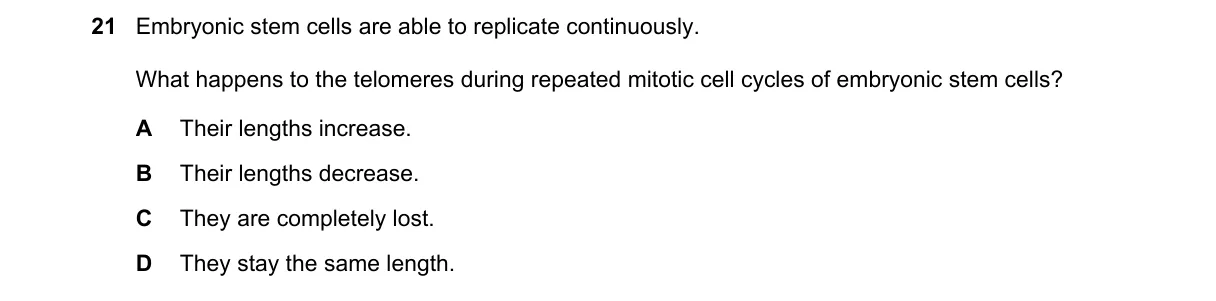
Explanation
Telomere Maintenance by Telomerase in Stem Cells
Steps:
- Telomeres are protective caps on chromosome ends that normally shorten during cell division due to incomplete DNA replication.
- Embryonic stem cells express high levels of telomerase, a reverse transcriptase enzyme.
- Telomerase adds telomeric DNA repeats to chromosome ends, counteracting shortening.
- This allows continuous replication without telomere loss, enabling indefinite division.
Why D is correct:
- Telomerase continuously replenishes telomeres in embryonic stem cells, maintaining their length as defined by the enzyme's role in preventing replicative senescence.
Why the others are wrong:
- A: Telomeres are maintained, not elongated beyond original length.
- B: Telomerase prevents the typical decrease seen in somatic cells.
- C: Telomeres do not erode to zero; telomerase ensures stability.
Final answer: D
Topic: Replication and division of nuclei and cells
Practice more A Levels Biology (9700) questions on mMCQ.me