A Levels Biology (9700)•9700/11/O/N/22
Explanation
Tertiary structure: 3D folding driven by R-group interactions
Steps:
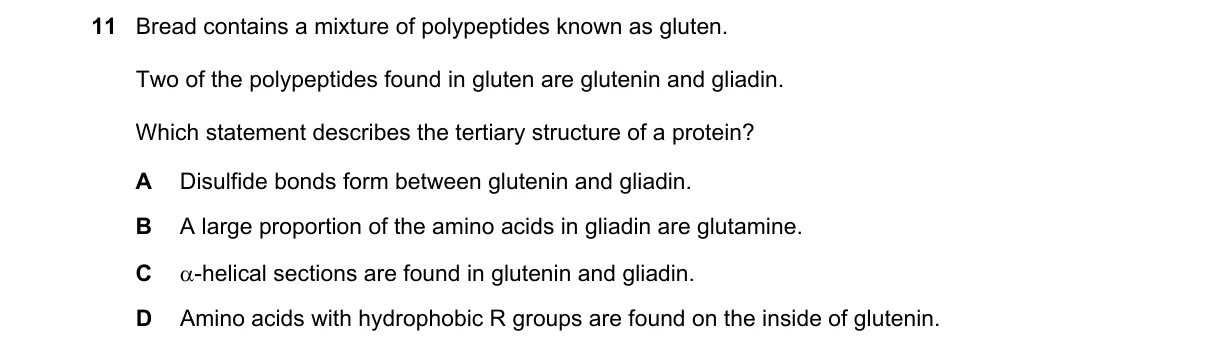
- Define tertiary structure as the spatial arrangement of a polypeptide chain stabilized by hydrophobic, ionic, H-bond, and disulfide interactions between side chains.
- Eliminate options describing other structure levels: primary (sequence), secondary (local folding like helices), quaternary (multi-subunit).
- Identify option matching R-group burial in folded protein core.
- Confirm D aligns with hydrophobic core formation in soluble proteins.
Why D is correct:
- In tertiary structure, hydrophobic R groups cluster inside the protein to minimize water contact, as per the hydrophobic effect principle.
Why the others are wrong:
- A describes quaternary structure, involving interactions between separate polypeptides like glutenin and gliadin.
- B refers to primary structure, the linear sequence rich in glutamine residues.
- C describes secondary structure, local α-helical conformations within the chain.
Final answer: D
Topic: Proteins
Practice more A Levels Biology (9700) questions on mMCQ.me