A Levels Biology (9700)•9700/12/O/N/21
Explanation
Cellulose as a linear β-glucose polymer
Steps:
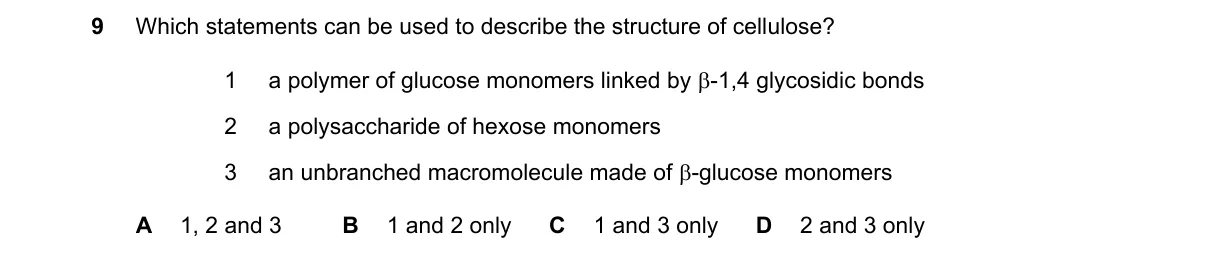
- Verify statement 1: Cellulose forms from glucose units via β-1,4 glycosidic bonds, confirming the linkage description.
- Verify statement 2: As a carbohydrate with hexose (six-carbon) glucose monomers, it qualifies as a polysaccharide.
- Verify statement 3: Cellulose consists of straight chains of β-D-glucose without branches, matching the unbranched macromolecule trait.
- Confirm all statements align with cellulose's known structure from plant cell walls.
Why A is correct:
- Cellulose is defined as an unbranched polysaccharide of β-glucose linked by β-1,4 glycosidic bonds, encompassing all three statements per biochemical standards.
Why the others are wrong:
- B omits 3, ignoring the unbranched β-glucose specificity.
- C omits 2, overlooking its polysaccharide classification.
- D omits 1, excluding the precise 1-4 glycosidic bond detail.
Final answer: A
Topic: Carbohydrates and lipids
Practice more A Levels Biology (9700) questions on mMCQ.me