A Levels Biology (9700)•9700/12/O/N/21
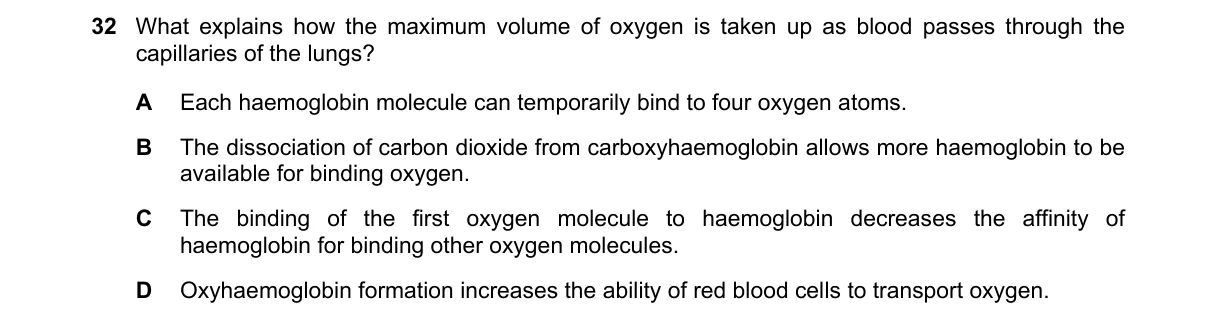
Explanation
Haemoglobin enables maximum oxygen uptake via oxyhaemoglobin formation
Steps:
- Identify the process: Oxygen diffuses into blood in lung capillaries and binds haemoglobin to form oxyhaemoglobin, saturating red blood cells.
- Evaluate capacity: Haemoglobin's structure allows binding up to four O2 molecules per unit, but maximum uptake relies on efficient transport mechanism.
- Consider binding dynamics: Cooperative binding ensures rapid saturation, but the key is how oxyhaemoglobin enhances overall oxygen carrying.
- Select best explanation: Option D directly links oxyhaemoglobin to increased red cell transport capacity, maximizing volume uptake.
Why D is correct:
- Oxyhaemoglobin formation binds oxygen reversibly to haemoglobin, increasing red blood cell oxygen-carrying capacity by up to 70 times compared to dissolved oxygen alone (per Fick's law of diffusion).
Why the others are wrong:
- A: Describes basic binding capacity but not the mechanism for maximum uptake in lungs.
- B: Incorrect; carboxyhaemoglobin involves carbon monoxide, not CO2, which doesn't dissociate to free haemoglobin for O2.
- C: False; initial O2 binding actually increases haemoglobin's affinity for subsequent O2 via positive cooperativity.
Final answer: D
Topic: Transport of oxygen and carbon dioxide
Practice more A Levels Biology (9700) questions on mMCQ.me