A Levels Biology (9700)•9700/12/O/N/21
Explanation
Properties of lymph and tissue fluid
Steps:
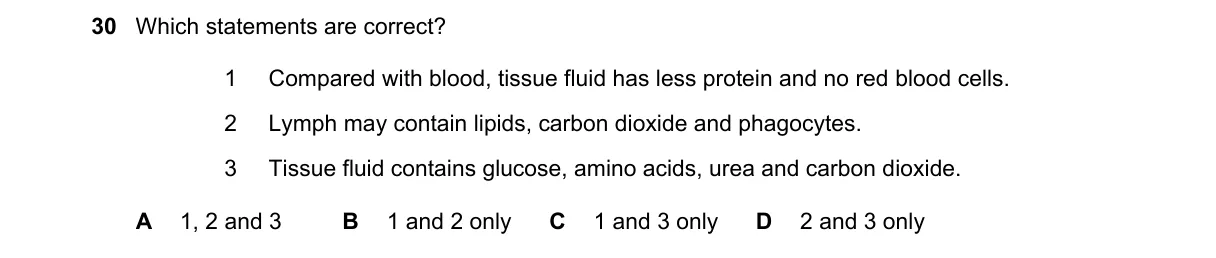
- Statement 1: Lymph derives from tissue fluid, which filters from blood plasma, losing most proteins and all blood cells, confirming less protein and no blood cells.
- Statement 2: Lymph absorbs dietary lipids in intestines (as chyle), carries CO2 from tissues, and includes phagocytic white blood cells from blood.
- Statement 3: Tissue fluid forms by blood capillary filtration, retaining small solutes like glucose, amino acids, urea, and dissolved CO2 from metabolism.
- All statements align with physiological definitions, so 1, 2, and 3 are correct.
Why A is correct:
- Lymph and tissue fluid compositions are defined by capillary exchange principles, where proteins and cells are excluded from lymph, while solutes and gases diffuse freely.
Why the others are wrong:
- B excludes 3, but tissue fluid does contain metabolic solutes.
- C excludes 2, but lymph transports lipids, CO2, and immune cells.
- D excludes 1, but lymph indeed has reduced proteins and lacks blood cells.
Final answer: A
Topic: The circulatory system
Practice more A Levels Biology (9700) questions on mMCQ.me