A Levels Biology (9700)•9700/11/O/N/21
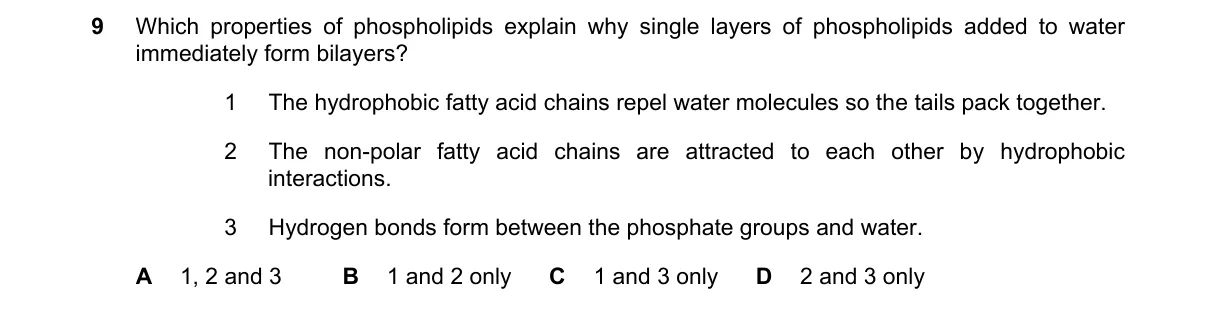
Explanation
Amphipathic Nature Drives Bilayer Formation
Steps:
- Phospholipids have hydrophilic heads that attract water and hydrophobic tails that repel it, making them amphipathic.
- In water, hydrophobic tails cluster together to minimize contact with water, while heads interact with the aqueous environment.
- A single layer cannot satisfy both; tails would be exposed, so molecules rearrange into a bilayer with tails inward and heads outward on both sides.
- This spontaneous structure minimizes free energy, explaining immediate bilayer formation.
Why A is correct:
- All three properties (1: hydrophilic heads; 2: hydrophobic tails; 3: amphipathic overall) define the driving force for bilayer assembly per hydrophobic effect principles.
Why the others are wrong:
- B omits amphipathicity, which integrates heads and tails for bilayer stability.
- C excludes hydrophobic tails, essential for inward clustering.
- D ignores hydrophilic heads, needed to face water on both bilayer surfaces.
Final answer: A
Topic: Fluid mosaic membranes
Practice more A Levels Biology (9700) questions on mMCQ.me