A Levels Biology (9700)•9700/11/O/N/21
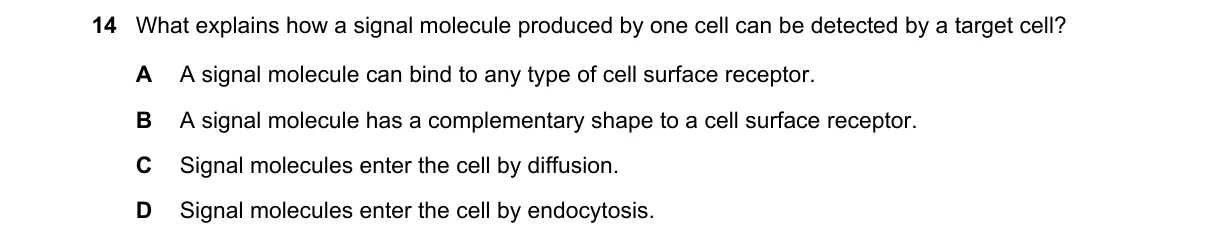
Explanation
Ligand-Receptor Binding in Cell Signaling
Steps:
- Signal molecules, or ligands, travel to target cells and interact with their surface.
- Detection occurs when the ligand fits specifically into a receptor protein on the cell membrane.
- This binding triggers intracellular responses, like enzyme activation or ion channel opening.
- Specificity ensures only target cells respond, based on complementary molecular shapes.
Why A is correct:
- Receptors act as locks, and signal molecules as keys with complementary shapes, enabling specific recognition per the lock-and-key model in biochemistry.
Why the others are wrong:
- B: Diffusion explains molecule transport, not detection by the target cell.
- C: Endocytosis internalizes some signals but is not the primary detection mechanism.
- D: Binding is specific to matching receptor types, not any receptor.
Final answer: A
Topic: Fluid mosaic membranes
Practice more A Levels Biology (9700) questions on mMCQ.me