A Levels Biology (9700)•9700/11/O/N/21
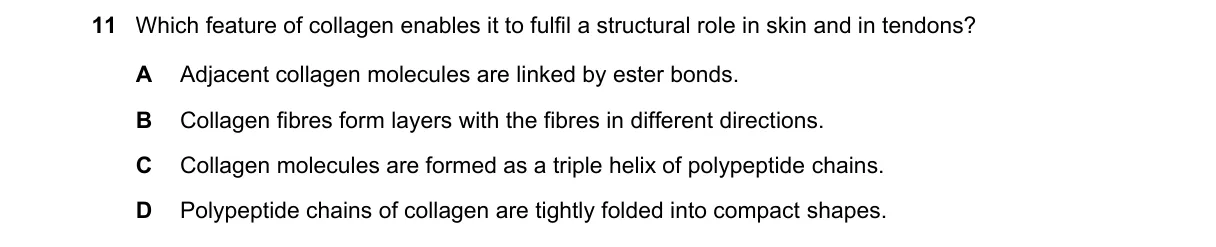
Explanation
Collagen's Triple Helix for Structural Strength
Steps:
- Recall collagen's role: provides tensile strength in connective tissues like skin and tendons.
- Examine options: identify which describes collagen's molecular structure enabling rigidity and resistance to stretching.
- Eliminate incorrect features: rule out bonds, folding, and layering that don't match collagen's primary structure.
- Confirm correct feature: triple helix allows parallel alignment for high tensile strength.
Why C is correct:
- Collagen's triple helix structure, formed by three polypeptide chains twisted together, creates a rigid, rope-like molecule that resists pulling forces, as defined in protein biochemistry for extracellular matrix support.
Why the others are wrong:
- A: Layers with different directions describe plywood-like organization in tissues, not collagen's inherent molecular feature.
- B: Ester bonds link carbohydrates or lipids, not adjacent collagen molecules, which use hydrogen and covalent bonds.
- D: Collagen chains form extended helices, not compact folds like globular proteins such as enzymes.
Final answer: C
Topic: Proteins
Practice more A Levels Biology (9700) questions on mMCQ.me