A Levels Biology (9700)•9700/13/O/N/20
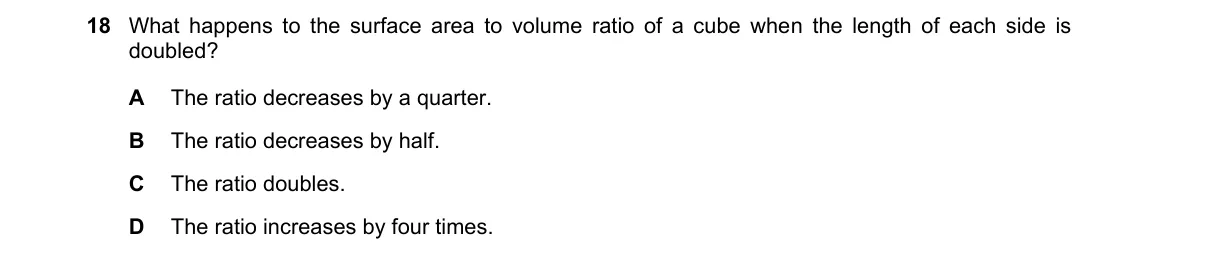
Explanation
Surface Area to Volume Ratio Scales Inversely with Side Length
Steps:
- For a cube with side length , surface area is and volume is , so ratio is .
- Doubling the side length gives new side .
- New surface area is ; new volume is .
- New ratio is , which is half of .
Why B is correct:
- The ratio is inversely proportional to side length (from ); doubling halves the ratio, per the scaling formula.
Why the others are wrong:
- A: Decreases by a quarter implies new ratio is of original, but it becomes .
- C: Ratio decreases, does not double.
- D: Ratio decreases, does not increase by a factor of four.
Final answer: B
Topic: Cells as the basic units of living organisms
Practice more A Levels Biology (9700) questions on mMCQ.me