A Levels Biology (9700)•9700/13/O/N/20
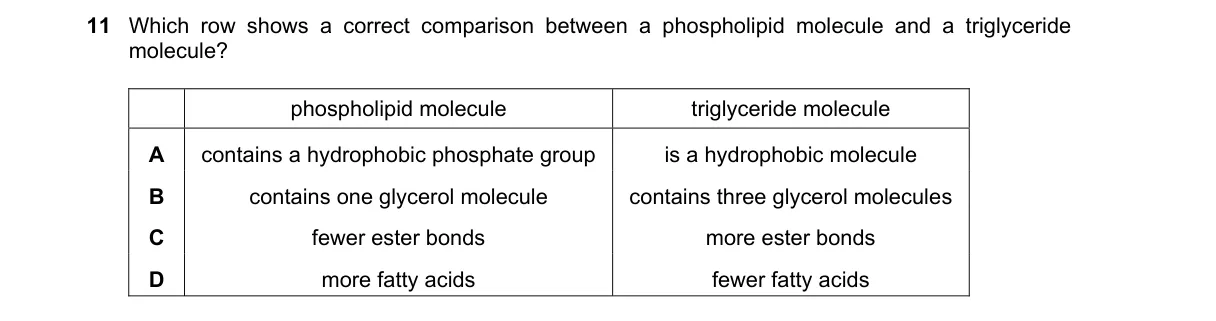
Explanation
Key structural differences in lipids Steps:
- Recall phospholipid structure: one glycerol with two fatty acids and one phosphate group attached via ester and phosphoester bonds.
- Recall triglyceride structure: one glycerol with three fatty acids attached via ester bonds.
- Compare components: phospholipids have two fatty acids for amphipathic properties; triglycerides have three for hydrophobicity and energy storage.
- Match to choice stating fewer fatty acids in phospholipids versus more in triglycerides.
Why D is correct:
- Phospholipids incorporate two fatty acid chains into a diacylglycerol-phosphate, while triglycerides form from triacylglycerol with three chains, per standard biochemical formulas.
Why the others are wrong:
- A: Phospholipids are amphipathic overall, not defined solely by a hydrophilic phosphate; ignores shared hydrophobic tails.
- B: Ester bond count mirrors fatty acid number (two vs. three), making this redundant and less direct than fatty acid comparison.
- C: Both contain one glycerol molecule; triglycerides use a single glycerol, not three.
Final answer: D
Topic: Carbohydrates and lipids
Practice more A Levels Biology (9700) questions on mMCQ.me