A Levels Biology (9700)•9700/12/O/N/20
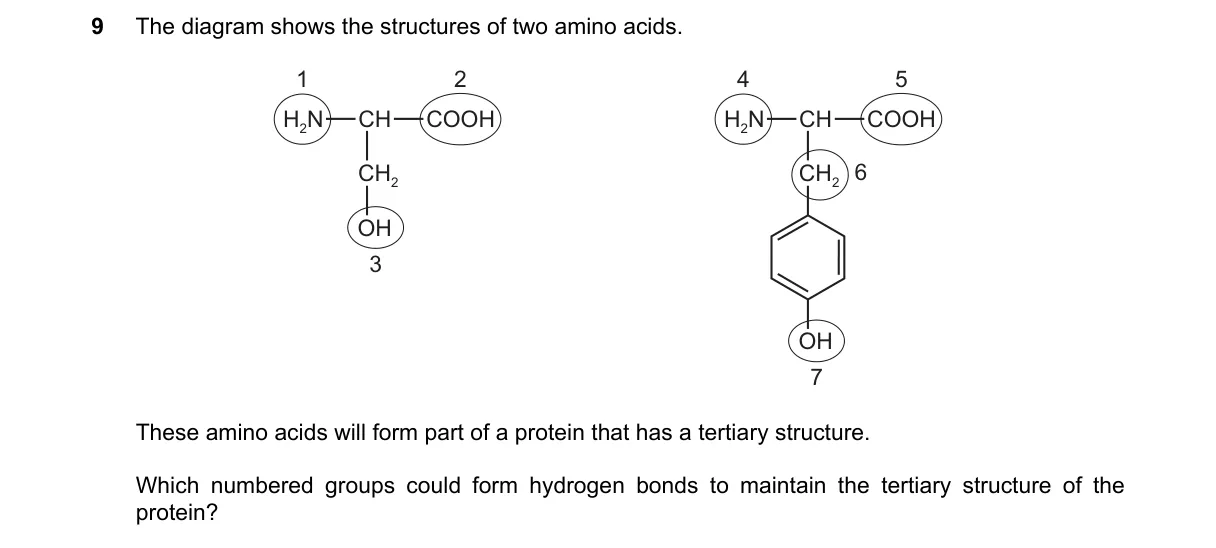
Explanation
Hydrogen Bonding in Protein Tertiary Structure Steps:
- Identify functional groups in amino acids capable of hydrogen bonding: typically -OH, -NH, or carbonyl groups.
- Examine the diagram for groups between the two amino acids that can act as hydrogen bond donors or acceptors.
- Determine which numbered groups align to form intramolecular bonds stabilizing the tertiary fold.
- Select the option where groups from side chains or backbone enable this interaction.
Why D is correct:
- Option D identifies polar groups (e.g., -OH and -NH) that form hydrogen bonds per the definition of H-bonding as attraction between electronegative atoms and H attached to N, O, or F.
Why the others are wrong:
- A: Involves nonpolar groups unable to form H-bonds.
- B: Features charged groups that repel or form ionic bonds, not H-bonds.
- C: Lacks complementary donor-acceptor pairs for H-bonding.
Not enough information: Diagram of amino acids and numbered groups not provided. Final answer: D
Topic: Proteins
Practice more A Levels Biology (9700) questions on mMCQ.me