A Levels Biology (9700)•9700/11/O/N/20
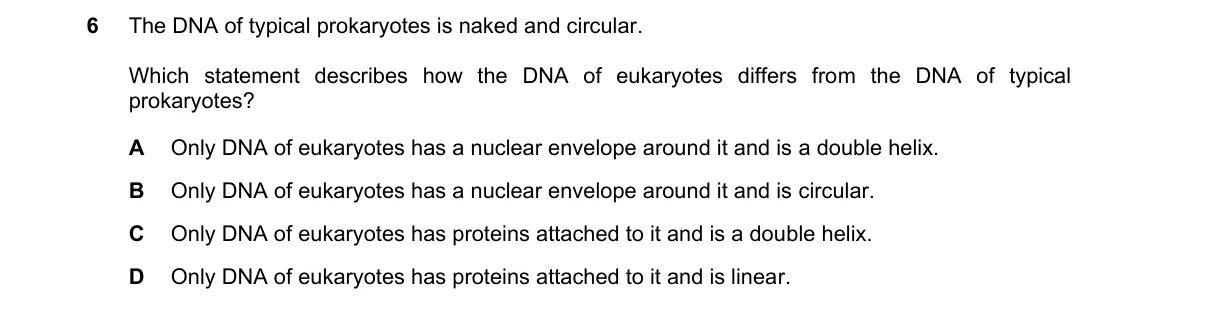
Explanation
Key Differences in Eukaryotic vs. Prokaryotic DNA Structure
Steps:
- Identify prokaryotic DNA as circular, located in nucleoid without nuclear envelope, and lacking histone proteins.
- Note eukaryotic DNA as linear, enclosed in nucleus with nuclear envelope, and associated with histone proteins for packaging.
- Confirm both types form a double helix structure.
- Evaluate options for features unique to eukaryotes: nuclear envelope, histones, and linearity.
Why D is correct:
- Eukaryotic DNA is linear and bound to histone proteins for chromatin formation, distinguishing it from prokaryotic circular DNA without histones (per cell biology definitions of genome organization).
Why the others are wrong:
- A: Both eukaryotic and prokaryotic DNA form a double helix.
- B: Prokaryotic DNA is circular, not eukaryotic.
- C: Both eukaryotic and prokaryotic DNA form a double helix.
Final answer: D
Topic: Structure of nucleic acids and replication of DNA
Practice more A Levels Biology (9700) questions on mMCQ.me