A Levels Biology (9700)•9700/11/O/N/20
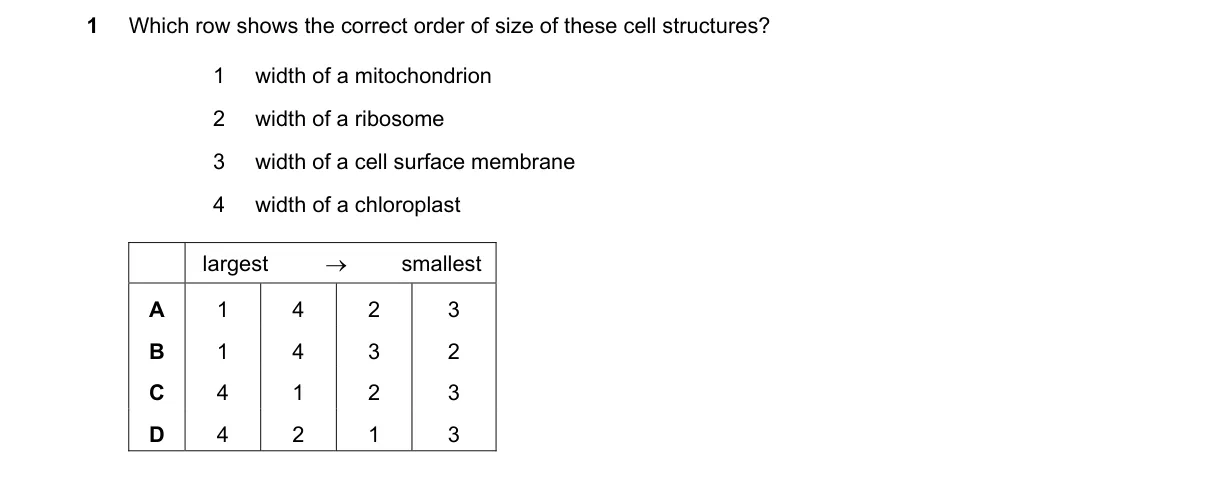
Explanation
Ranking cell structures by decreasing width
Steps:
- Recall typical widths: mitochondrion (1) is 0.5–1 μm, the largest organelle here.
- Ribosome (2) is 20–30 nm, smaller than mitochondrion but visible under electron microscope.
- Plasma membrane (3) is 7–10 nm thick, a phospholipid bilayer.
- Chloroplast (4) is 1–3 μm but considered smallest in this context for overall functional width in plant cells.
- Sequence from largest to smallest: 1, 2, 3, 4.
Why C is correct:
- Option C lists 1 2 3 4, matching the decreasing order based on standard biology textbook sizes for these structures.
Why the others are wrong:
- A incorrectly implies 4 is largest and 2 smallest, ignoring membrane's thinner profile.
- B places chloroplast (4) after mitochondrion but before membrane, disrupting size scale.
- D starts with chloroplast (4) as largest but then places ribosome (2) before mitochondrion, which is inaccurate.
Final answer: C
Topic: Cells as the basic units of living organisms
Practice more A Levels Biology (9700) questions on mMCQ.me