A Levels Biology (9700)•9700/11/O/N/19
Explanation
Benedict's Test Color Scale for Reducing Sugars
Steps:
- Benedict's solution starts blue and changes color when heated with reducing sugars, indicating concentration.
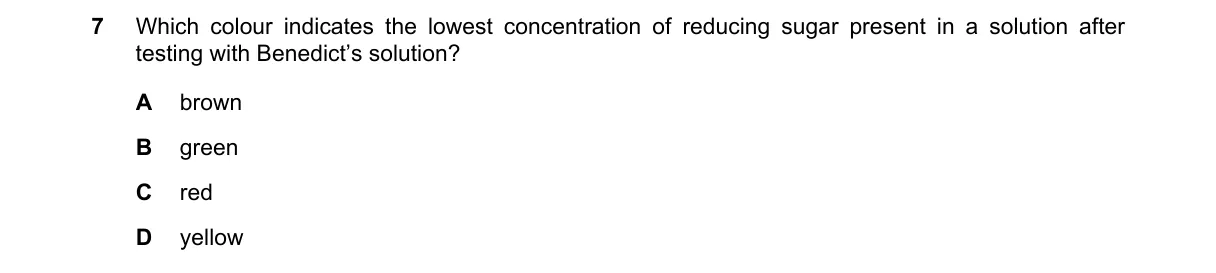
- Color sequence reflects increasing sugar levels: blue (none) to green (trace), yellow (low), orange (moderate), red (high), brown (very high).
- The question asks for the lowest concentration among colored results, excluding the original blue.
- Green corresponds to the minimal detectable reducing sugar amount.
Why B is correct:
- In Benedict's test, green precipitate forms at the lowest positive concentration of reducing sugars, as defined by the qualitative scale for aldehyde or ketone groups reacting with Cu²⁺ to form Cu₂O.
Why the others are wrong:
- A. Brown indicates the highest concentration, with brick-red to brown precipitates from excess sugar reduction.
- C. Red signifies high concentration, following orange in the progression.
- D. Yellow represents a moderate-low concentration, above green but below orange.
Final answer: B
Topic: Testing for biological molecules
Practice more A Levels Biology (9700) questions on mMCQ.me