A Levels Biology (9700)•9700/11/O/N/19
Explanation
Matching adaptations to phloem and xylem cell types
Steps:
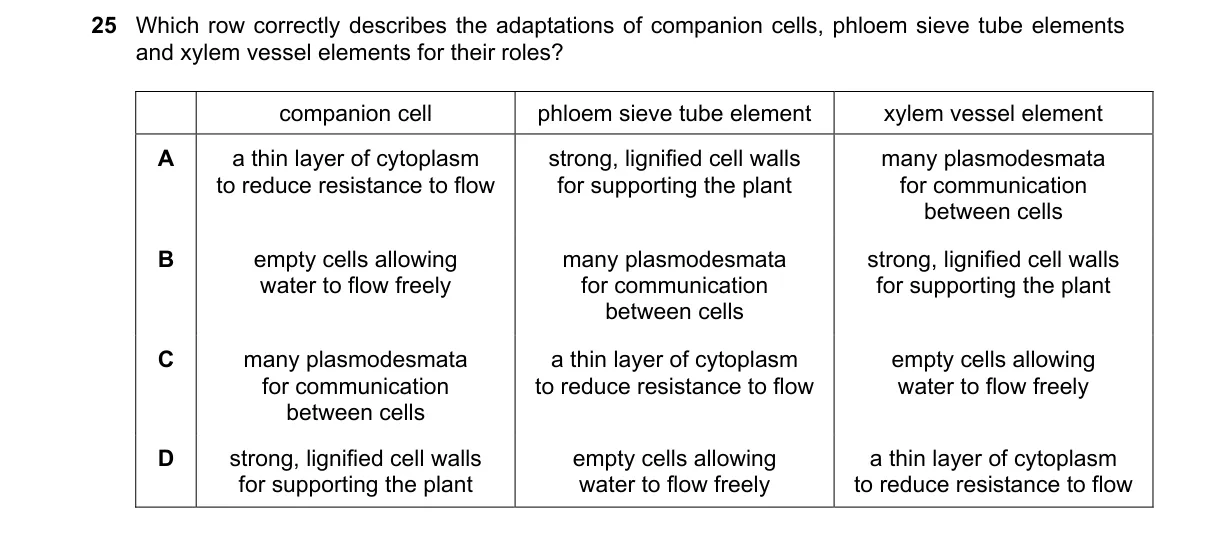
- Companion cells have many plasmodesmata for communication and nutrient exchange with sieve tubes.
- Phloem sieve tube elements possess a thin layer of cytoplasm to minimize resistance during sap flow.
- Xylem vessel elements are empty, dead cells enabling unobstructed water transport.
- Option C correctly sequences these: plasmodesmata (companion), thin cytoplasm (sieve tubes), empty cells (xylem).
Why C is correct:
- Aligns with plant transport tissue anatomy, where companion cells connect via plasmodesmata, sieve tubes streamline flow with minimal cytoplasm, and xylem vessels provide open conduits per the cohesion-tension theory.
Why the others are wrong:
- A: Misassigns lignified walls to companion cells, which are living and unlignified.
- B: Incorrectly attributes empty cells to phloem and plasmodesmata to xylem, reversing tissue roles.
- D: Swaps order, assigning lignified walls to companion cells instead of xylem.
Final answer: C
Topic: Structure of transport tissues
Practice more A Levels Biology (9700) questions on mMCQ.me