A Levels Biology (9700)•9700/11/O/N/19
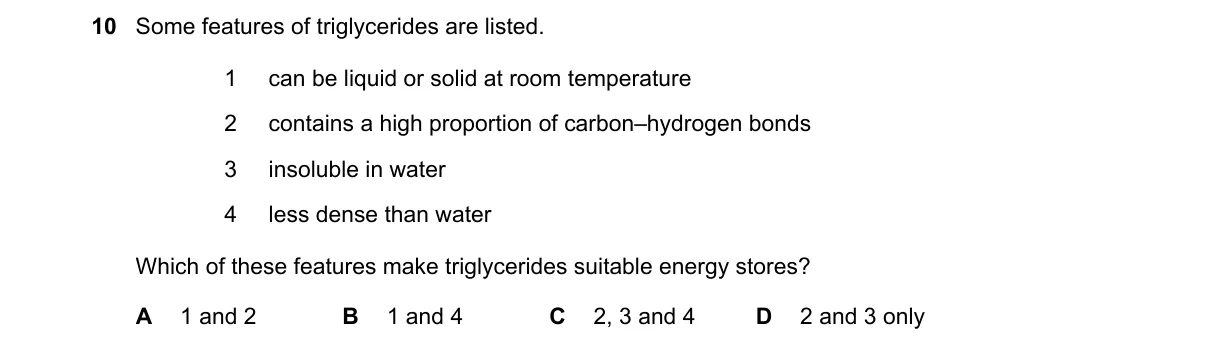
Explanation
Triglycerides' Properties for Energy Storage
Steps:
- Identify key requirements for energy stores: compact, hydrophobic to avoid water interactions, and low density to prevent buoyancy issues in organisms.
- Evaluate feature 1 (liquid/solid state): Affects usability but not core storage suitability.
- Evaluate feature 2 (high C-H bonds): Indicates energy richness but not why suitable for storage.
- Evaluate features 3 and 4 (insoluble, less dense): Enable aggregation without dissolving or sinking.
Why D is correct:
- Insolubility (3) allows triglycerides to form anhydrous droplets in cells without osmotic disruption, per lipid biochemistry; low density (4) ensures flotation in cytoplasm, optimizing space per the principle of neutral buoyancy in adipose tissue.
Why the others are wrong:
- A: Feature 1 influences form (e.g., fats/oils) but not storage efficiency; 2 provides energy but doesn't address storage logistics.
- B: Feature 1 is secondary; 4 aids buoyancy, but lacks hydrophobicity essential for isolation.
- C: Feature 2 is energetic but irrelevant to storage; 3 is key, but pairing ignores density's role in positioning.
Final answer: D
Topic: Carbohydrates and lipids
Practice more A Levels Biology (9700) questions on mMCQ.me