A Levels Biology (9700)•9700/13/O/N/18
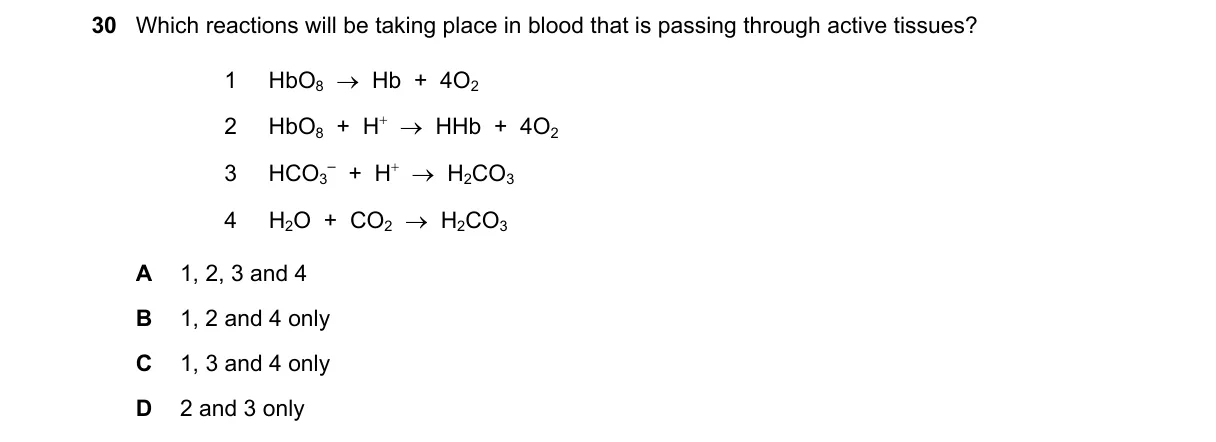
Explanation
Gas exchange and buffering in active tissues
Steps:
- Active tissues generate CO₂ and lactic acid, raising blood H⁺ and PCO₂.
- Elevated H⁺ triggers hemoglobin to release O₂ (reaction 1: HbO₂ + H⁺ → Hb + O₂, Bohr effect).
- H⁺ from metabolism is buffered by HCO₃⁻ forming H₂CO₃ (reaction 3: HCO₃⁻ + H⁺ → H₂CO₃).
- CO₂ reacts with water to form carbonic acid, aiding transport (reaction 4, implied carbonic anhydrase activity).
- Reaction 2 (likely reverse or unrelated, e.g., O₂ binding) does not occur under acidic conditions.
Why B is correct:
- B selects reactions 1, 3, and 4, matching Bohr effect (O₂ unloading via H⁺) and bicarbonate buffer system (HCO₃⁻ + H⁺ → H₂CO₃ → CO₂ + H₂O) for O₂ delivery and CO₂ handling in tissues.
Why the others are wrong:
- A includes incorrect reaction 2, which opposes tissue conditions.
- C omits buffering (3) and CO₂ transport (4), incomplete for acid load.
- D excludes O₂ release (1) and CO₂ step (4), missing key gas exchange.
Final answer: B
Topic: Transport of oxygen and carbon dioxide
Practice more A Levels Biology (9700) questions on mMCQ.me