A Levels Biology (9700)•9700/12/O/N/18
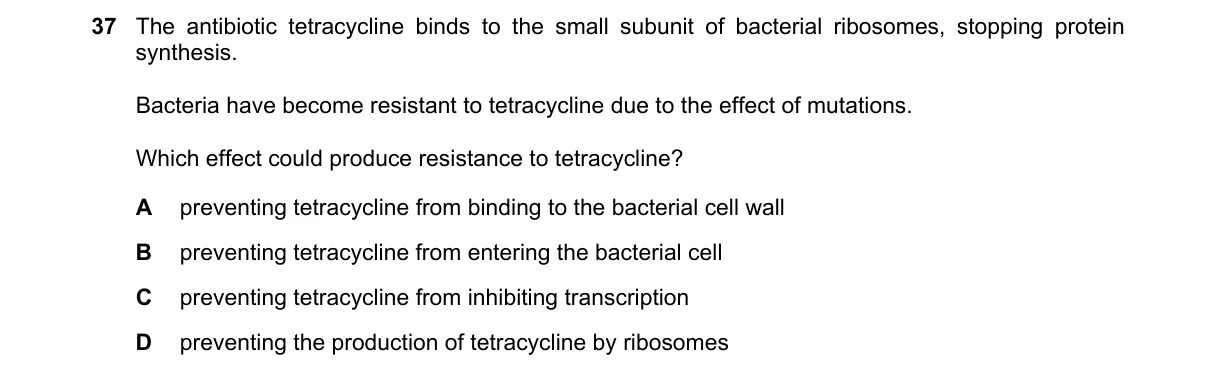
Explanation
Bacterial Resistance via Impaired Antibiotic Entry
Steps:
- Tetracycline inhibits protein synthesis by binding the 30S ribosomal subunit inside bacterial cells.
- Mutations can confer resistance by altering drug uptake, target binding, or efflux.
- Resistance requires blocking the antibiotic's access to its intracellular target (ribosomes).
- Evaluate choices: only impaired entry prevents the drug from reaching ribosomes.
Why B is correct:
- Tetracycline acts intracellularly on ribosomes; preventing entry blocks access to the target site, per antibiotic pharmacodynamics.
Why the others are wrong:
- A: Tetracycline targets ribosomes, not the cell wall, so binding there is irrelevant.
- C: Tetracycline inhibits translation (protein synthesis), not transcription (RNA synthesis).
- D: Ribosomes synthesize proteins, not antibiotics like tetracycline; this misrepresents the mechanism.
Final answer: B
Topic: Antibiotics
Practice more A Levels Biology (9700) questions on mMCQ.me