A Levels Biology (9700)•9700/11/O/N/18
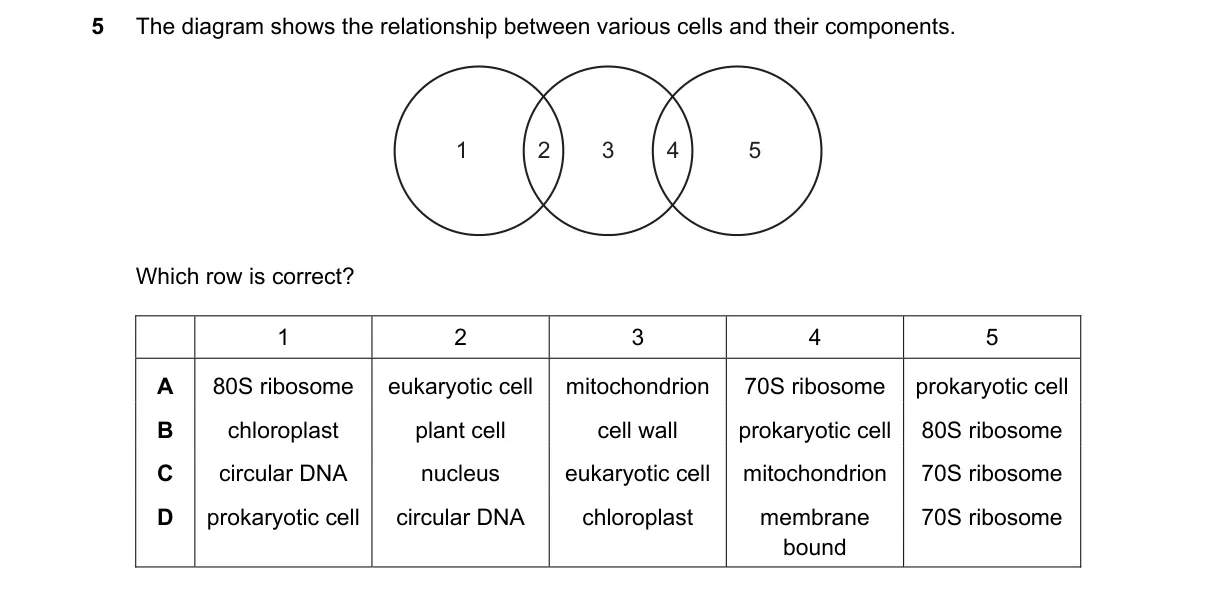
Explanation
Endosymbiotic features in eukaryotic organelles
Steps:
- Identify cell types: prokaryotic cells lack nucleus and membrane-bound organelles; eukaryotic cells have them.
- Recall organelle origins: chloroplasts and mitochondria derive from prokaryotes via endosymbiosis, retaining prokaryotic traits like 70S ribosomes and circular DNA.
- Analyze sequences: match diagram relationships to prokaryotic components in eukaryotic structures.
- Select option aligning prokaryotic ribosomes with chloroplast in plant cells.
Why A is correct:
- Chloroplasts in plant cells (eukaryotic) contain prokaryotic 70S ribosomes, per endosymbiotic theory.
Why the others are wrong:
- B: Nuclei in eukaryotic cells have linear DNA, not circular; membrane-bound ribosomes are 80S eukaryotic.
- C: Prokaryotic cells lack chloroplasts, which are eukaryotic organelles.
- D: Mitochondria in eukaryotic cells have 70S ribosomes but are not prokaryotic cells themselves.
Final answer: A
Topic: Cells as the basic units of living organisms
Practice more A Levels Biology (9700) questions on mMCQ.me