A Levels Biology (9700)•9700/11/O/N/18
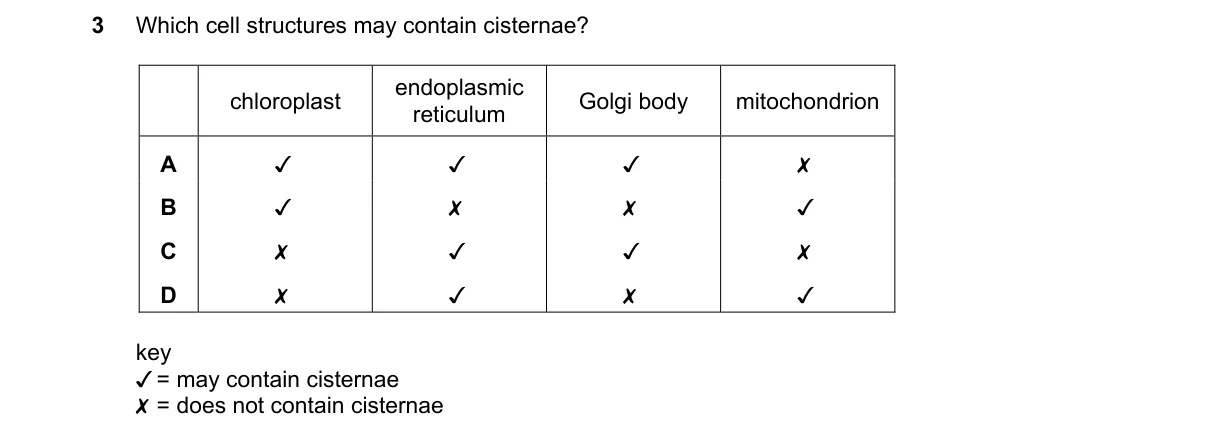
Explanation
Cell structures with cisternae: ER and mitochondrion
Steps:
- Recall that cisternae are flattened, sac-like membrane structures in eukaryotic cells.
- Identify organelles with stacked or networked membranous sacs: endoplasmic reticulum (ER) forms cisternae in its rough and smooth regions.
- Check mitochondrion: its inner membrane folds into cristae, which include cisternal-like compartments for enzyme housing.
- Eliminate options lacking these features: chloroplasts have thylakoids, Golgi has distinct stacked cisternae but not paired with mitochondrion here.
Why C is correct:
- Cisternae are defined as membrane-bound sacs; ER contains a network of them for protein/lipid processing, and mitochondria have cristae with cisternal spaces for ATP production.
Why the others are wrong:
- A: Chloroplasts contain thylakoids (disc-shaped sacs), not true cisternae.
- B: Omits mitochondrion, which also features cisternal structures in cristae.
- D: Golgi body has stacked cisternae but excludes ER, the primary site.
Final answer: C
Topic: Cells as the basic units of living organisms
Practice more A Levels Biology (9700) questions on mMCQ.me