A Levels Biology (9700)•9700/14/M/J/25
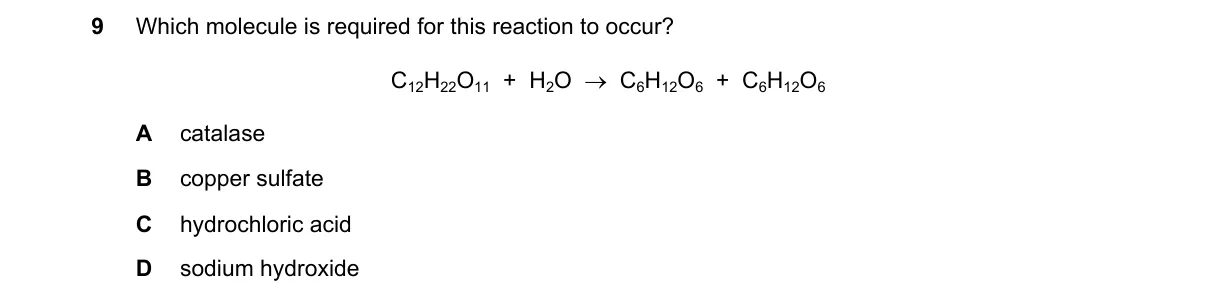
Explanation
Amphoteric dissolution of Cu(OH)₂ requires excess base
Steps:
- Identify the reaction: Cu(OH)₂ reacts with water to form the tetrahydroxocuprate(II) ion, [Cu(OH)₄]²⁻, indicating amphoteric behavior.
- Balance the equation: Actual reaction is Cu(OH)₂ + 2OH⁻ → [Cu(OH)₄]²⁻, showing need for additional hydroxide ions beyond H₂O.
- Recall Cu(OH)₂ solubility: Insoluble in water alone but dissolves in strong base like NaOH to form the complex.
- Match to choices: Select the base that supplies OH⁻ ions.
Why D is correct:
- Sodium hydroxide (NaOH) provides excess OH⁻ ions, driving the formation of [Cu(OH)₄]²⁻ per the amphoteric dissolution formula.
Why the others are wrong:
- A. Catalase is an enzyme that decomposes H₂O₂, unrelated to metal hydroxide complexes.
- B. Copper sulfate (CuSO₄) is a copper source but not required for this specific hydroxide reaction.
- C. Hydrochloric acid (HCl) is an acid that reacts with Cu(OH)₂ to form soluble CuCl₂, not the basic complex.
Final answer: D
Topic: Testing for biological molecules
Practice more A Levels Biology (9700) questions on mMCQ.me