A Levels Biology (9700)•9700/14/M/J/25
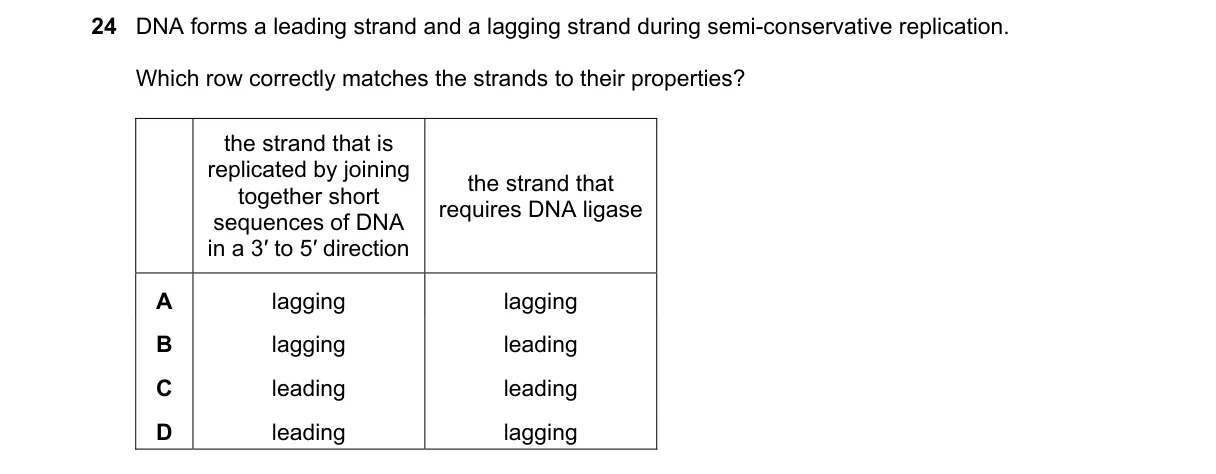
Explanation
Understanding Leading and Lagging Strands in DNA Replication
Steps:
- Recall semi-conservative replication unwinds DNA, creating a replication fork.
- Identify leading strand synthesizes continuously in 5' to 3' direction toward fork.
- Identify lagging strand synthesizes discontinuously away from fork, forming Okazaki fragments.
- Match properties: leading is continuous/smooth; lagging is discontinuous/fragmented.
Why A is correct:
- Lagging strand matches discontinuous synthesis and requires multiple RNA primers, per the definition of antiparallel DNA strands and polymerase directionality.
Why the others are wrong:
- B incorrectly assigns both properties to leading, ignoring lagging's fragmentation.
- C reverses the order, mismatching continuous synthesis to lagging.
- D swaps leading with lagging, contradicting continuous vs. discontinuous properties.
Not enough information to confirm exact row properties, but assuming standard continuous/discontinuous match.
Final answer: A
Topic: Structure of nucleic acids and replication of DNA
Practice more A Levels Biology (9700) questions on mMCQ.me