A Levels Biology (9700)•9700/14/M/J/25
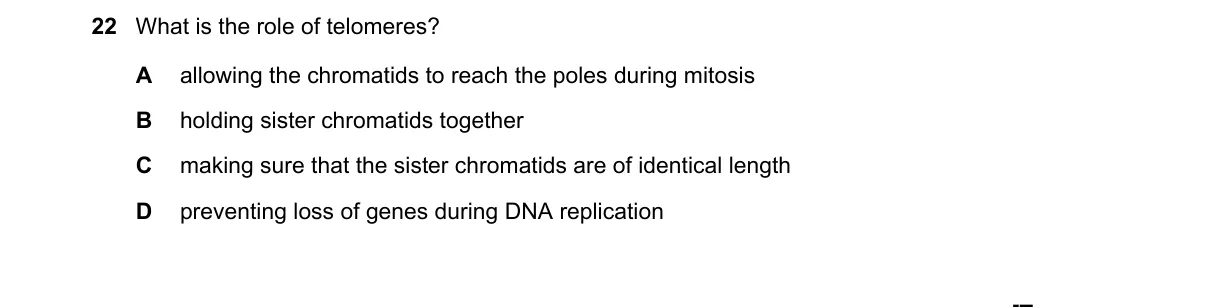
Explanation
Telomeres protect chromosome ends during DNA replication
Steps:
- Recall that DNA replication shortens chromosomes slightly each cycle due to the end-replication problem.
- Identify telomeres as repetitive, non-coding DNA sequences at chromosome ends.
- Understand telomeres act as buffers, sacrificing themselves to prevent essential genes from being lost.
- Eliminate options unrelated to replication protection, confirming D as the match.
Why D is correct:
- Telomeres cap chromosome ends, preventing the loss of genetic information during incomplete replication of linear DNA, as defined by the end-replication problem in molecular biology.
Why the others are wrong:
- A: Chromosome movement to poles is handled by the mitotic spindle, not telomeres.
- B: Sister chromatids are held by cohesin proteins, not telomeres.
- C: Chromatid length identity is ensured by semi-conservative replication, not telomeres.
Final answer: D
Topic: Structure of nucleic acids and replication of DNA
Practice more A Levels Biology (9700) questions on mMCQ.me