A Levels Biology (9700)•9700/13/M/J/25
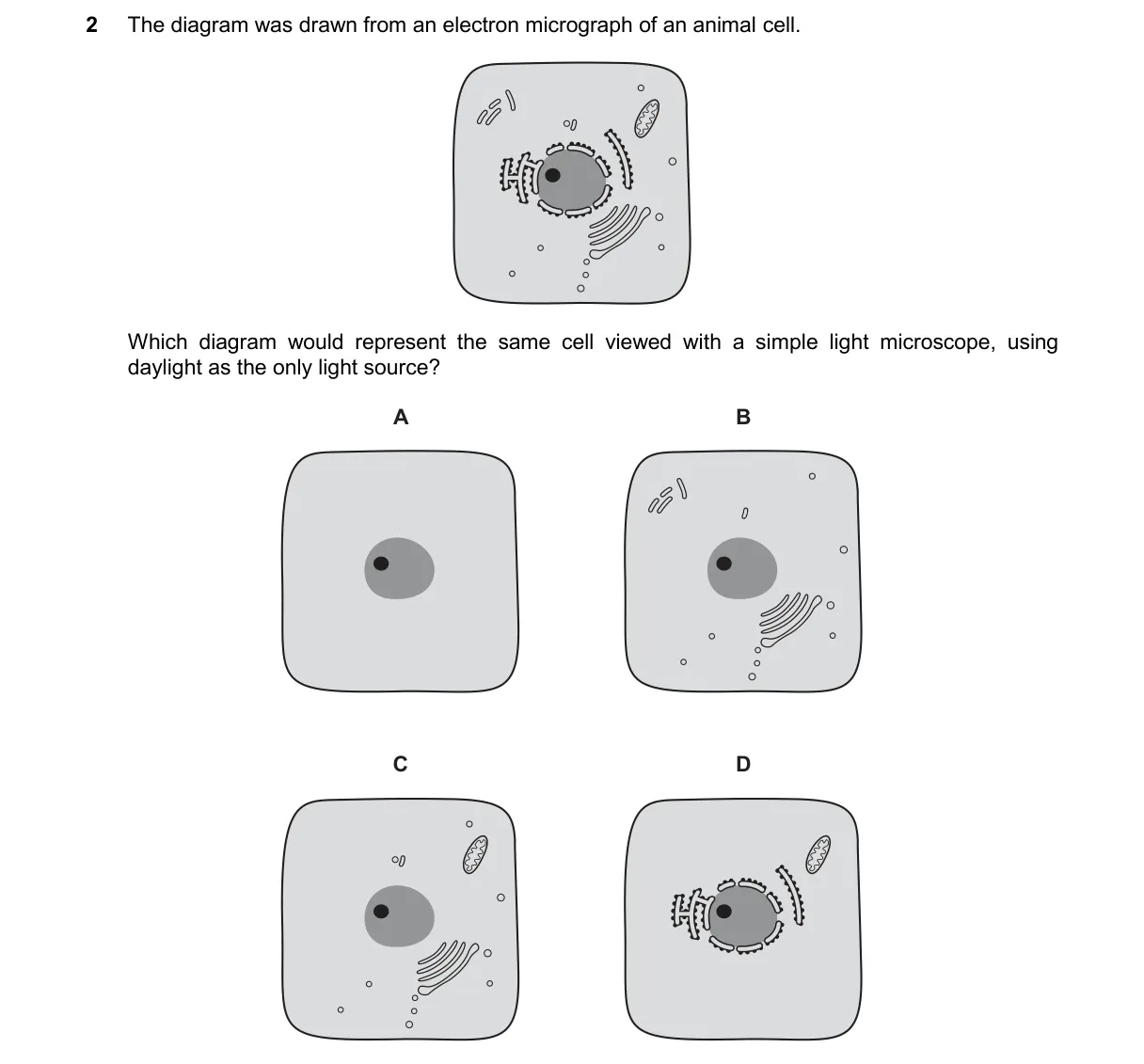
Explanation
Resolution Limits of Light vs. Electron Microscopy
Steps:
- Electron microscopes resolve structures down to 0.2 nm using electron beams, revealing fine details like membranes and ribosomes.
- Light microscopes resolve only down to 200 nm using visible light, showing basic cell features like nucleus and cytoplasm.
- Daylight as light source provides natural illumination without staining, limiting visibility to unstained, larger components.
- Select diagram matching light microscope's lower resolution and natural appearance.
Why A is correct:
- Diagram A depicts only large, visible structures like the nucleus, aligning with the Abbe diffraction limit (resolution ≈ λ/2NA, where λ is light wavelength ~500 nm).
Why the others are wrong:
- B shows excessive fine details like organelles, requiring electron-level resolution.
- C includes artificial colors or stains, not possible with unstained daylight viewing.
- D lacks key visible features like the nucleus, underrepresenting light microscope capabilities.
Final answer: A
Topic: The microscope in cell studies
Practice more A Levels Biology (9700) questions on mMCQ.me