A Levels Biology (9700)•9700/12/M/J/25
Explanation
Branching inversely affects hydrolysis completeness by limiting access to α-1,4 bonds Steps:
- Enzyme X hydrolyzes α-1,4 glycosidic bonds from non-reducing ends, releasing maltose units until reaching branch points.
- Amylose has no branches (all α-1,4 links), allowing full access and complete hydrolysis.
- Amylopectin branches every ~24-30 monomers via α-1,6 bonds, leaving some limit dextrin but more hydrolysis than glycogen.
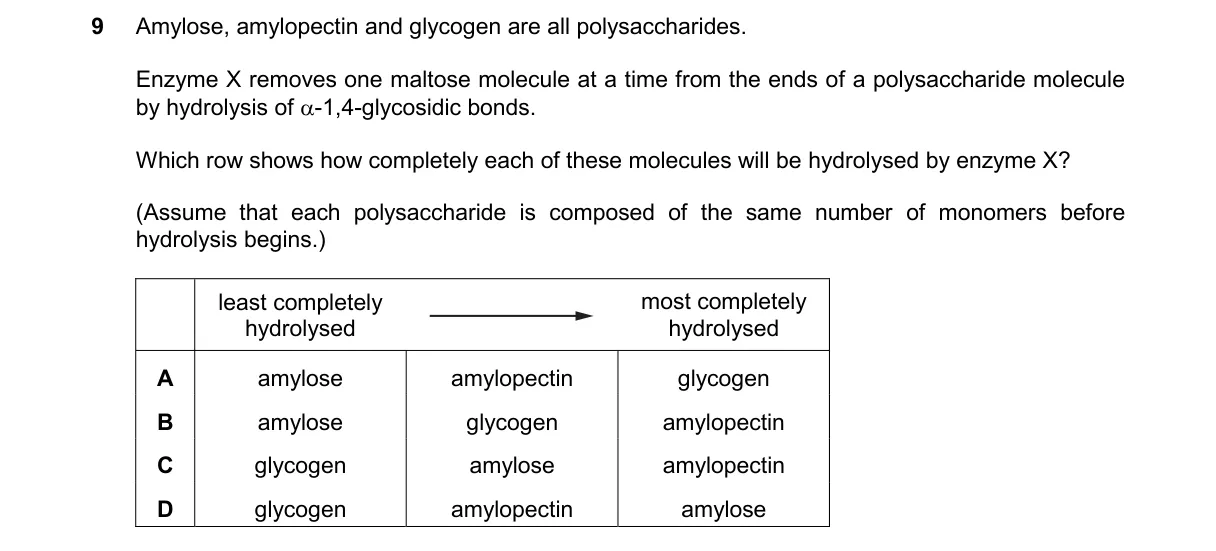
- Glycogen branches every ~8-12 monomers, creating shorter linear segments and larger limit dextrin, so least hydrolysis. Why D is correct:
- D orders polysaccharides from least to most completely hydrolysed (glycogen most branched/lowest yield, amylopectin intermediate, amylose unbranched/full yield), matching the inverse relation to branching frequency. Why the others are wrong:
- A: Reverses the order, starting with most complete (amylose) instead of least.
- B: Places amylopectin before amylose, ignoring amylose's higher completeness due to no branches.
- C: Places amylose (most complete) before amylopectin (less complete), disrupting the increasing order.
Final answer: D
Topic: Carbohydrates and lipids
Practice more A Levels Biology (9700) questions on mMCQ.me