A Levels Biology (9700)•9700/12/M/J/25
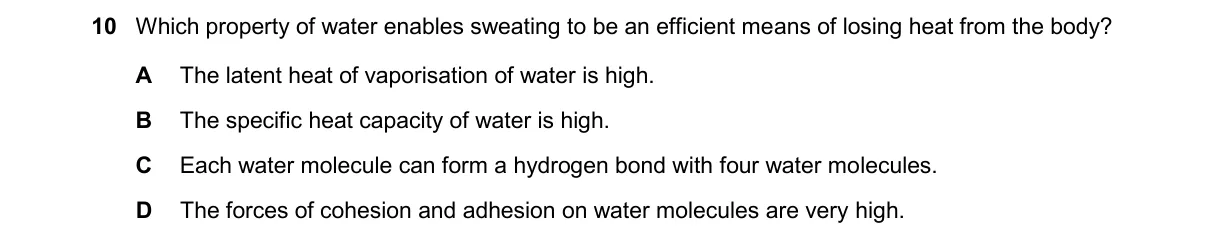
Explanation
Water's High Latent Heat Enables Efficient Cooling via Evaporation
Steps:
- Sweating produces water on the skin that evaporates to remove heat.
- Evaporation requires energy to break intermolecular bonds, absorbed from the body.
- The property determining energy per unit mass during phase change is latent heat of vaporization.
- High value means more heat removed per gram of sweat evaporated.
Why A is correct:
- Latent heat of vaporization is the energy (about 2260 J/g) needed to vaporize water at constant temperature, allowing significant body heat loss without much sweat volume.
Why the others are wrong:
- B: Specific heat capacity (4.18 J/g°C) governs heat absorption for temperature rise in liquid water, not phase change during evaporation.
- C: Hydrogen bonding enables four bonds per molecule, contributing to cohesion but not directly to the heat absorbed in vaporization.
- D: High cohesion and adhesion cause surface tension, aiding capillary action but irrelevant to evaporative heat loss.
Final answer: A
Topic: Water
Practice more A Levels Biology (9700) questions on mMCQ.me