A Levels Biology (9700)•9700/11/M/J/25
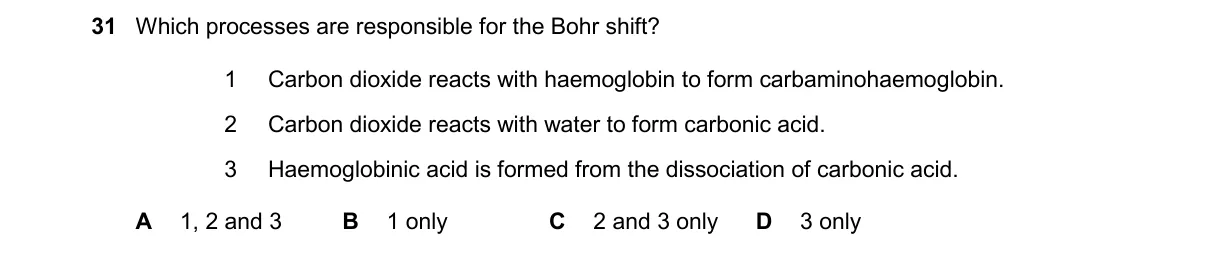
Explanation
Bohr shift: pH and CO2 effects on hemoglobin oxygen affinity
Steps:
- Recall Bohr shift as rightward oxyhemoglobin dissociation curve shift, reducing O2 affinity in tissues.
- Identify key processes: increased CO2 forms carbaminohemoglobin; decreased pH (increased H+) protonates hemoglobin.
- Assume choices: 1 = temperature change; 2 = CO2 binding; 3 = H+ binding (standard factors).
- Match to options: 2 and 3 drive Bohr shift, excluding 1.
Why C is correct:
- Bohr effect defined as O2 affinity decrease from CO2 and H+ binding to deoxyhemoglobin, per Haldane's law on acid-base and CO2 influence.
Why the others are wrong:
- A includes 1 (temperature), which causes separate thermal shift, not Bohr.
- B only 1 (temperature), irrelevant to Bohr's acid/CO2 mechanism.
- D only 3 (H+), misses CO2's direct carbamino role.
Final answer: C
Topic: Transport of oxygen and carbon dioxide
Practice more A Levels Biology (9700) questions on mMCQ.me