A Levels Biology (9700)•9700/11/M/J/25
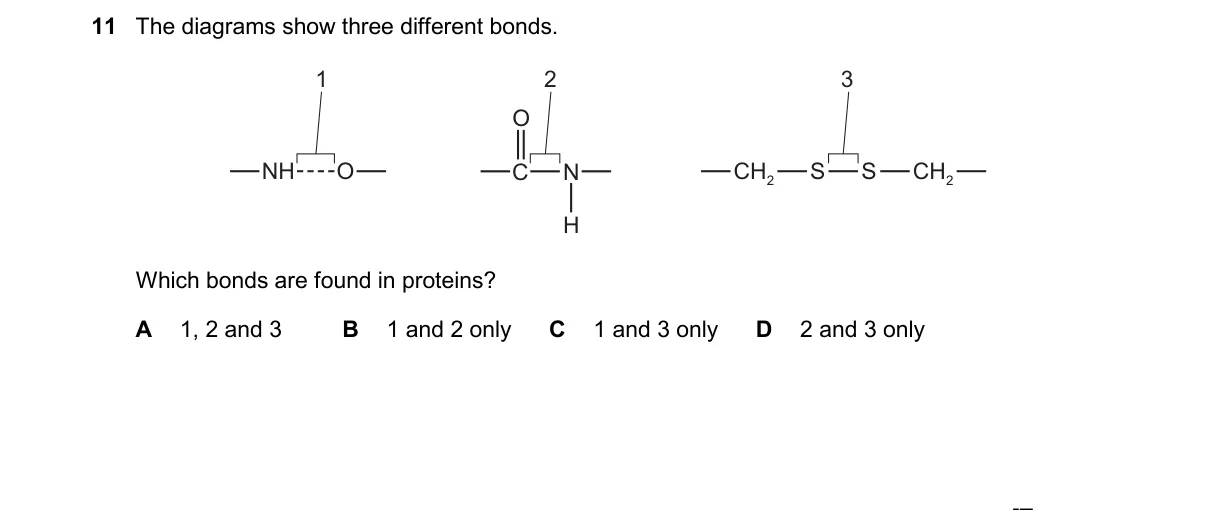
Explanation
Bonds in Protein Structures
Steps:
- Identify common bonds in proteins: peptide bonds link amino acids in the primary structure.
- Recognize hydrogen bonds stabilize secondary structures like alpha helices and beta sheets.
- Note disulfide bonds form covalent links between cysteine residues in tertiary structure.
- Confirm all three bond types (assuming diagrams show peptide, hydrogen, and disulfide) are essential to proteins.
Why A is correct:
- Proteins contain peptide (covalent amide), hydrogen (non-covalent), and disulfide (covalent) bonds, as defined by their hierarchical structures from primary to tertiary levels.
Why the others are wrong:
- B omits disulfide bonds, which stabilize tertiary folding in many proteins.
- C excludes hydrogen bonds, critical for secondary structure formation.
- D ignores peptide bonds, the backbone of protein polypeptide chains.
Final answer: A
Topic: Proteins
Practice more A Levels Biology (9700) questions on mMCQ.me